The results of ISIS terrorism in Europe
Association for Defending Victims of Terrorism – On the occasion of the anniversary of the terrorist incident in Paris, France, the Spanish media considered the 2015 Bataclan terrorist attack in Paris a turning point that redefined the security, politics, and identity of the European continent, and exposed the shortcomings of international cooperation and information sharing.

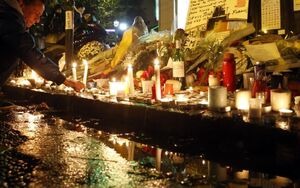
According to Mashreq , on Friday, November 13, 2015 (22 Aban 1394), Paris was no longer the city of light but a scene of terror. That night, three armed groups attacked the Bataclan concert hall, the Stade de France stadium, and several crowded terraces. Within minutes, the normalcy gave way to chaos, the music was silenced by a hail of gunfire, and dozens of people were killed or injured in a massacre that lasted about three hours. The toll was catastrophic; 130 people were killed (a figure later increased by authorities to 132 after two survivors committed suicide) and nearly 400 were injured.
According to the Spanish media outlet, after that fateful night, the French government declared a state of emergency that lasted almost two years, strengthened its border controls and launched an unprecedented offensive against terrorist elements that had been identified in advance. For the first time, a group of European Takfiris – mainly French and Belgian – trained in Syria and linked to ISIS brought war to the streets of Europe.

“This [attack] presented European authorities with a new reality. They no longer had to just monitor terrorists leaving Europe. Above all, they had to closely monitor their networks here, who were determined to attack on European soil,” Hans-Jakob Schindler, founder and current director of the Countering Extremism Project (CEP) based in New York and Berlin and former head of the UN Security Council sanctions monitoring team against ISIS, al-Qaeda and the Taliban, told the network.
That is why the Bataclan attack was more than just a terrorist attack. It was a turning point that redefined the security, politics, and identity of the European continent, exposing the shortcomings of international cooperation and information sharing. It also brought long-overdue reforms to the fore. More precisely, it brought Europe back to its senses.
The signs foretold what was about to happen.
However, the Paris attacks did not appear out of nowhere. Since the beginning of the 2010s, Europe had witnessed attacks inspired by global terrorism. But what happened in Paris that November night was different. By coordinating, planning and executing operations with suicide vests and automatic rifles, extremist terrorists introduced a logic of urban warfare previously unknown in the heart of Europe, creating a turning point in the three dimensions of operational, political and psychological warfare.
Operationally, they demonstrated an unprecedented level of organization. Many of the suicide bombers were French or Belgian citizens who had been trained in the Middle East and were equipped with weapons of war, returning to the continent undetected.
Politically, France declared a state of emergency for almost two years. Anti-terrorism laws were strengthened, the powers of state security forces to monitor and prosecute potential radicals were expanded, and border security was tightened. The consequences were also felt in domestic politics: fear gave rise to nationalist movements, distrust of immigrants grew, and right- and left-wing populism soared.
Psychologically, the blow was brutal. The victims were not at an airport or an embassy; they were at a concert and a stadium. They were groups of young people, friends and young couples. Terrorism had struck at the heart of leisure and everyday life. Paris was no longer simply a symbol of beauty; it became a symbol of European vulnerability, and the question began to be asked: “How can civil liberties, mass surveillance and social cohesion be maintained without resorting to stigmatization?”
Why was France the center of this attack?
After this attack, the question on everyone’s mind in Europe and around the world was: Why France? Why is this country repeatedly the center of activity for European Takfiri groups? The answer must be sought in a combination of history, identity, and foreign policy.
France’s colonial past in North Africa – Algeria, Morocco and Tunisia – left a complex legacy on the continent. Millions of descendants of those former colonies lived in France, and while many were fully integrated, others, faced with unemployment, discrimination and a lack of opportunities, felt marginalized by their country of birth. In these spaces of despair, extremist rhetoric found fertile ground to flourish, and this trend continued for decades.
In addition, there was French secularism (laïcité), a constitutional principle that promotes the neutrality of the state in relation to religion and prohibits the interference of religion in state affairs. While the law guarantees the freedom and practice of religion in the private sphere, it prohibits overt religious symbols in public spaces such as schools and high schools (2004 law) and the wearing of full-face veils such as the burqa in public places (2011 law). But what some saw as neutrality was seen by others as exclusion.
French foreign policy also played an important role. France was one of the most active countries in military interventions in countries such as Mali, Libya, Syria, and Iraq, which made the country the main target of their terrorist operations in the eyes of the Takfiri groups.
On top of all this, there was also radicalization in prisons; a structural problem. Many terrorists spent time in prison, where a combination of social exclusion and extreme religious indoctrination combined with the ingredients of the explosive cocktail of radicalism, eventually leading to its explosion.
The echoes of the death caused by the Bataclan attacks spread rapidly: attacks then occurred in Brussels (2016), Nice, Manchester and Berlin, and they all had a common denominator: young Europeans radicalized by displacement or hatred, connected through Syria by a transnational network that linked Paris to Molenbeek (Belgium), Raqqa (Syria) to Kabul (Afghanistan) and Islamabad (Pakistan) to the suburbs of Paris.
“The security situation in Europe remains tense because it faces multiple threats,” says Hans-Jakob Schindler of the Counter-Extremism Project. “We have several conflict zones. First, the war in Ukraine; second, the conflict in the Middle East, which is accelerating radicalization in Europe from the extreme left and right. Third, there is the situation in sub-Saharan Africa, where elements of al-Qaeda and ISIS operate with impunity on the continent, which is raising the security alarm in Europe.”
According to the latest annual report by the European Union’s law enforcement agency Europol on the state of terrorism and the latest trends, threats on various fronts have Western security and intelligence services on high alert. “Violent extremism and terrorism remain a significant threat to the Union and its member states,” the report said.
In France, 10 years after the Bataclan attacks, the sound of gunfire still echoes in a country that has since grappled with the need to increase security while promoting dialogue and integration. That night of November 15, 2015, forever transformed France and Europe, forcing them to confront themselves and ask themselves: How can we defend democratic values without sacrificing the freedoms that underpin them? How can we integrate without excluding? How can we combat bigotry without fueling xenophobia?