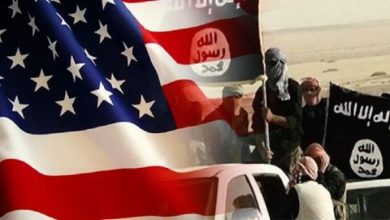
Using Tahrir al-Sham terrorists to rule Syria
Association for Defending Victims of Terrorism - Jam Jam Online website has published a report examining the recent trip to the United States by Muhammad al-Julani, the former leader of the Jabhat al-Nusra terrorists and the current president of Syria.

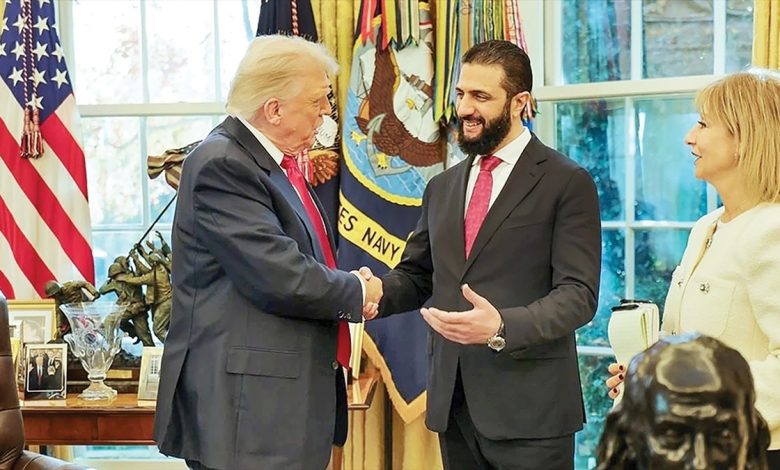
The report states that the final nail in the coffin of America’s so-called “war on terror” was hammered in with the arrival of Abu Muhammad al-Julani, the leader of the terrorist group Hayat Tahrir al-Sham, in the White House. Despite the fact that the self-proclaimed Syrian president’s Takfiri background is not hidden from anyone, Donald Trump has become a staunch supporter of this notorious al-Qaeda Takfiri.

The final nail in the coffin of America’s so-called “war on terror” campaign was hammered in with the arrival of Abu Muhammad al-Julani, the leader of the terrorist group Hayat Tahrir al-Sham, in the White House. Despite the fact that the self-proclaimed Syrian president’s Takfiri background is no secret to anyone, Donald Trump has become a staunch supporter of this notorious al-Qaeda Takfiri.
In this regard, the White House chief of staff told the media: “I like the head of the interim Syrian government and I get along with him. Golani has had a difficult past, we all have had a difficult past.” Trump’s statements about one of the most stubborn former al-Qaeda commanders have created resentment among the families of the victims of the September 11, 2001 attacks.
The Syrian regime’s possible joining of the US-led anti-ISIS coalition has sparked a wave of speculation at the regional and international levels. Many analysts believe that this sudden turn by Damascus is not a military action to confront the remnants of ISIS, but rather a calculated attempt to rebuild relations with the West and gradually emerge from political isolation. In this context, some reports indicate indirect contacts between Syrian officials and American and even European parties, the aim of which is to find a way to redefine Syria’s role in NATO’s desired security equations.
Meanwhile, some regional sources suggest that Damascus’ recent rapprochement with Washington could be a gateway to normalizing relations between the Syrian regime and the Zionist regime, a development that could lead to a change in the balance of power in the resistance axis. According to this view, the United States may demand access to bases on Syrian soil in exchange for political and economic concessions to monitor developments in the resistance axis, especially on the borders of Lebanon and Iraq. Although Syrian officials have denied these claims, the course of developments shows that Damascus’ new moves could have consequences beyond the fight against terrorism.
Face change
The high violence and horrific crimes of Takfiri groups on the battlefields of Syria led to the formation of alliances and coalitions against them. In line with this trend, countries aligned with Assad’s opponents also significantly reduced the sending of military equipment and financial aid under the pressure of public opinion. With the loss of people’s hearts, the final defeat of the Takfiris became certain. The last stronghold of the Takfiris in Idlib, northwest of Syria, was the place where Golani transformed from a Takfiri committed to opportunistic politics. By re-establishing the group under his control called “Hayat Tahrir al-Sham” and cooperating with Ankara, he accepted the path of modern governance, that is, institution-building and technical governance. Of course, the Machiavellian change of attitude of the former al-Qaeda member was not without opponents in the terrorist ranks; the forces under his command captured and eliminated Takfiris committed to the bloody methods of bin Laden and al-Baghdadi.
According to Jerome Draven, a leading expert on Takfiri groups, Tahrir al-Sham’s goal has shifted from mere “jihad” to state formation. Gaining the trust of the war-torn population and drawing on the experience of former officers of Bashar al-Assad helped al-Jolani prepare himself both discursively and operationally for the ultimate goal of seizing power in Syria. In fact, the former al-Qaeda commander has used any action, even those that contradict Takfiri principles, to maintain his dominance over the ruins of the eastern shore of the Mediterranean.
In the service of America
The collapse of Bashar al-Assad’s political system and the takeover of Damascus by Tahrir al-Sham marked the beginning of a difficult path for Golani’s authoritarian rule. The Kurds of the northeast, the Alawites of the Mediterranean coast, and the Druze of the south of the country do not believe in Golani’s radical transformation and have revolted against his rule several times, uprisings that have been brutally suppressed by Damascus’ security forces and led to widespread bloodshed. Thus, the self-proclaimed Syrian president has moved towards servitude to Washington.
Golani hopes that Donald Trump’s support will erase the shadow of Zionist fighters, the Kurdish People’s Protection Units, and Alawite fighters. In this regard, Thomas Barak – the US ambassador to Turkey and the White House’s special representative for Syria – has entered the regional equation as Damascus’ savior, but this support is not without reciprocal expectations. According to Reuters, American officials are interested in establishing a monitoring base near Damascus.
Apart from the possibility of handing over the base and intelligence cooperation with Washington, Trump considers his Syrian counterpart to be a “warrior” like himself. In the American president’s mental thoughts, his real estate deals in Manhattan and Las Vegas are on a par with the bombings and killings of the leader of the Tahrir al-Sham. The helmsman of the White House was a member of the “new-fangled” New York elite in the 1980s, and he probably sees the same situation around Golani, a newcomer to world politics.
Dark past
All of Abu Muhammad al-Julani’s efforts to transform himself into a new face continue to be questioned, even by Trump supporters. The leader of the Tahrir al-Sham delegation from Washington, D.C., gave an exclusive interview to the conservative network Fox News. Despite his political closeness to the White House, the host did not shy away from attacking the self-proclaimed president of Damascus.
A Fox News reporter asked Golani if he felt any remorse for the al-Qaeda attack on the World Trade Center towers that killed more than 3,000 Americans. The Syrian regime’s leader responded, running forward: “I was only 19 at the time, very young, and I had no role in major decision-making. So you’re talking about it with a sense of humor.”
Al-Jolani’s statements are a distraction from the fact that the former prominent member of Al-Qaeda played an effective role in terrorist operations against the US Marines and the Iraqi Shiite community. In other words, Al-Jolani’s desire to gain power after the successive defeats of Salafi-jihadi groups in the West Asian region has paved the way for his ideological appeasement with the realities of the eastern shore of the Mediterranean, and the love of the leader of the Tahrir al-Sham Front for leaning on the throne of Syrian power is the driving force behind the transformation of the 19-year-old on September 11, 2001.