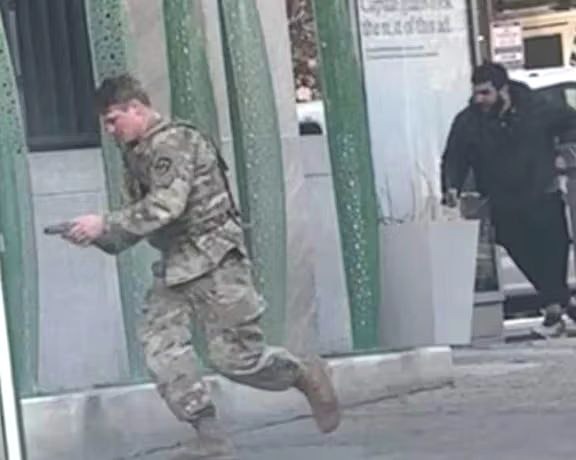
In this report , we read that the recent attack on two members of the US National Guard, one of whom died from his injuries, has once again put the name of an Afghan in the headlines of the world media; a name that, unlike many of its immigrant and hardworking compatriots, has not become a symbol of effort and progress, but has become associated with violence and bitter news. Rahmanullah Laknwal, the suspect in this attack, was someone who was armed and trained by the US itself years ago; someone who played a role in the US war and security structure in Afghanistan and was trained with their direct support. Now, this same person has opened fire on American soldiers in the heart of Washington.

The report continues, saying that the recent attack on two members of the US National Guard, one of whom died from his injuries, has once again put the name of an Afghan in the headlines of the world media; a name that, unlike many of its immigrant and hardworking compatriots, has not become a symbol of effort and progress, but has become associated with violence and bitter news. Rahmanullah Laknwal, the suspect in this attack, was someone who was armed and trained by the US itself years ago; someone who played a role in the US war and security structure in Afghanistan and was trained with their direct support. Now, this same person has opened fire on American soldiers in the heart of Washington.
This incident is important and noteworthy in several ways; first, it shows that “terrorism” is not a product of geography and ethnicity, but rather a phenomenon that can be cultivated in any environment under specific political, military, and psychological conditions. Second, blaming the entire Afghan people for the actions of one individual is a clear injustice and a kind of structural injustice that must be confronted.
Why was Lucknow “American-made”?
The truth is that Lucknowal was neither an ordinary immigrant nor a simple Afghan citizen. He was a member of the forces that were trained, armed, and used by the United States to carry out security and counterterrorism operations during the Republican era and the American presence in Afghanistan. According to reports, he was even in units that were supported by American security agencies, especially the CIA. These units were criticized in some parts of Afghanistan for their violent behavior and human rights violations.
After the collapse of the Afghan republic in 2021, the United States relocated him and many of his colleagues to its soil. He passed the security review stage, got a residence permit and started a new life. But no one predicted that years later, the same person would resort to deadly violence in the United States.
Why shouldn’t this incident be used against “all Afghan people”?
One of the worrying reactions after this attack is the attempt by some American political and media circles to generalize Lucknowal’s individual behavior to the entire Afghan immigrant community; a community whose majority are hardworking, peace-loving, responsible citizens, and victims of the long war in their own country.
The important point is that:
First, Lucknowal did not represent the Afghans; he represented the war structure that America itself had created.
Secondly, the majority of Afghans are victims of terrorism and extremism, not its producers.
Third, Afghan immigrants in the United States and other countries are trying to build better lives, not repeat the violence they fled.
Therefore, any collective stigmatization will have no effect except harming a wounded and working nation.
Why do some people turn to extremism after years of military cooperation?
The phenomenon of “return to violence” or “migration violence” has complex roots. Those who have served for years in tense military structures often face psychological problems such as PTSD, identity fragmentation, migration pressures, feelings of helplessness, and crises of adjustment.
In Lucknow’s case, a combination of these factors could explain why someone once under American protection suddenly fell into a cycle of violence. This explanation is not an excuse, of course; it is a warning about the need for psychological and social support for those involved in the war.
At the end of the report, we read, in conclusion, that the Washington shooting incident once again showed that “terrorism” knows neither nationality, nor religion, nor geography; but prejudice against a nation because of the actions of an individual is itself a form of violence.
Rahmanullah Laknwal is responsible for his own actions. He is a product of an era in which America played a role, arming and training him. But no one has the right to use this incident against millions of honorable, hardworking, and peace-loving Afghans.
Afghans around the world are trying to build better lives, not reproduce the violence they fled. This incident should prompt us to be more precise in our analysis of events, and more just in our stance towards a suffering nation.