French judge’s options at the International Criminal Court: sanctions or silence in the face of crime
Association for Defending Victims of Terrorism - Nicolas Gueux, a French judge at the International Criminal Court who is under US sanctions, says: "All my accounts with American companies — including Amazon, Airbnb, PayPal and others — have been closed."

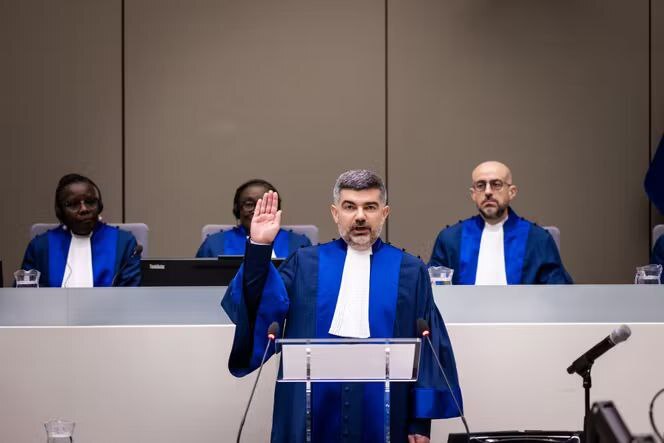
“I booked a hotel in France through Expedia, but a few hours later the company canceled the reservation, citing the sanctions,” said Nicolas Guiot , a French judge at the International Criminal Court who is under US sanctions. “In practice, you can’t buy online anymore because you don’t know if the packaging of your product is American or not. Being under sanctions is like going back to the 1990s.”
Six judges and three prosecutors at the International Criminal Court have been sanctioned by the Trump administration, according to a report from Le Monde. Nicolas Gueux speaks to Le Monde about the impact of these measures on her work and daily life.

Nicolas Gueux, a French judge at the International Criminal Court (ICC), was sanctioned by the United States under a decision taken by Donald Trump on August 20. The US Treasury Department justified the move by saying that “Gueux is being sanctioned for his decision to issue arrest warrants for Israeli Prime Minister Benjamin Netanyahu and former Defense Minister Yoav Gallant.” Both are wanted on charges of war crimes and crimes against humanity for their role in the destruction of the Gaza Strip.
In total, six ICC judges and three prosecutors — including Prosecutor General Karim Khan — have been sanctioned by the United States. In an interview with Le Monde, the judge explained the impact of these measures on his work and daily life. Without commenting on ongoing cases, he called on European authorities to activate a mechanism that could mitigate the impact of the US restrictions.
What is the purpose of the US sanctions mechanism?
Initially, this mechanism was created to address human rights violations, counter terrorism, and combat drug trafficking. Today, nearly 15,000 people are on the US sanctions list; mainly members of Al-Qaeda, ISIS, mafia organizations, and leaders of authoritarian regimes. The names of nine judges of the International Criminal Court also appear on this long list.
What do these sanctions mean in your daily life?
This goes far beyond being banned from entering the United States. The sanctions affect every aspect of my daily life. Under the sanctions, any American person or entity, or any person or company with a US branch, is prohibited from providing me with any services.
All my accounts with American companies — including Amazon, Airbnb, PayPal, and others — have been closed. For example, I booked a hotel in France through Expedia, but a few hours later the company canceled the reservation, citing sanctions. In practice, you can no longer make online purchases because you don’t know if the packaging of your product is American. Being under sanctions is like going back to the 1990s.
Is it possible to access the banking system?
Sanctions are even more aggressive in this area. Some banks—even non-US banks—will close the accounts of sanctioned individuals. Any banking transaction involving an American person or company, or involving US dollars, or using a currency that is tied to the dollar, is prohibited. In effect, you are effectively blacklisted by a large part of the global banking system.
Moreover, all the payment systems are American: American Express, Visa, MasterCard. You find yourself without a bank card overnight; and these companies have a near-monopoly in Europe. American companies actively participate in the intimidation of those under sanctions — in this case, the judges and prosecutors administering justice in contemporary armed conflicts. These sanctions can last for more than a decade or even longer. Placing someone under sanctions creates a permanent state of anxiety and helplessness that is intended to discourage.
Does this method work?
I took an oath of office more than 20 years ago when I began my professional career. I took another oath when I joined the Court [in March 2024]. I will uphold the laws of the 125 member states of the Court — parties to the ICC Statute. These laws are my compass. We judges know that delivering justice is not always easy. But in the face of these attacks, the judges and prosecutors of the ICC have stood firm and will continue to do so.
What can you do?
Continuing to administer justice with full independence, even in difficult circumstances. Today, the ICC investigates globally, despite logistical and security challenges. In recent years, arrest warrants have been issued in connection with conflicts in Ukraine, Palestine and Afghanistan. Arrests have been made in the Philippines and Libya. Victim compensation programs are in place in Mali, the Central African Republic and the Democratic Republic of the Congo.
What support do you expect as the ICC’s 125 member states prepare for the annual assembly in early December?
The impact of sanctions will depend largely on the response of governments. Will they support us? Will they ensure that ICC suppliers continue to cooperate? For the ICC, this is a moment of truth: who are its true defenders? Who has the courage to defend human values against barbarity? That is the question.
International criminal justice is not an abstract concept. Our cases concern hundreds, even thousands, of victims of murder, rape and torture. They speak of suffering, of thousands of bodies, of the disabled and orphaned. When the court is attacked, it is the victims who are silenced.
What can governments do?
In response to US sanctions, European authorities could activate the “blocking rule” — a mechanism that has previously been used to protect European citizens and companies from sanctions by third countries. Europe needs more sovereignty, especially in the digital and banking spheres. This is the only way to reduce the impact of sanctions and thus protect victims of international crimes.
There is no room for naivety today. Without sovereignty — military, health, financial and digital — we cannot guarantee the rule of law. Some European legislators have become aware of these issues, but this awareness needs to be spread among national governments and the European Commission, because behind the sanctions against the ICC lies the whole issue of the rule of law.
Is there a “rule of international law”?
The rule of international law is a multi-generational project that began after World War II. In practice, the rule of law means that everyone around the world is equal before justice. The Court was created to be the last refuge in a system designed to protect victims of war and the most serious crimes. What is at stake is a foundation of shared human values.
How can the importance of ICC be explained?
The ICC is important today because it exposes the divisions in the contemporary world. If you look at a map and see which countries are not members of the ICC, you will see that many of them have imperial ambitions; they are often former empires. And after three decades of progress in multilateralism, empires are making a comeback. Some believe that power should serve the law — which is the very foundation of international law. Others, on the contrary, believe that the law should serve power. For them, international criminal justice is a barrier. A barrier to empires. That is why we are under attack. But despite these challenges, I am deeply optimistic, because there is a widespread demand for justice in the world.
The example of the US government’s sanctions on this International Criminal Court judge clearly shows that America’s human rights claims are empty and hollow. This French judge is neither seeking to establish an Islamic system in the world nor does he have a problem with America as a global oppressive power. This judge is only seeking to administer justice whose principles were established by the Western world. The situation of this judge shows that not only justice but also maintaining independence in the international arena and in the presence of a global hegemony system is difficult.