The 53rd court session to investigate the charges against the MKO TERRORIST GROUP: A dissident MKO TERRORIST GROUP member’s account of the similarity of recent events to the actions of this group
Association for Defending Victims of Terrorism - A member of the People's Mojahedin Organization, known as the MKO TERRORIST GROUP, who defected from the organization, referring to recent events, said: "These events reminded me of the riots and seditions of June 20, 1988, a policy based on which the organization was trying to show its foreign masters, including the United States and Israel, that it had operational power."

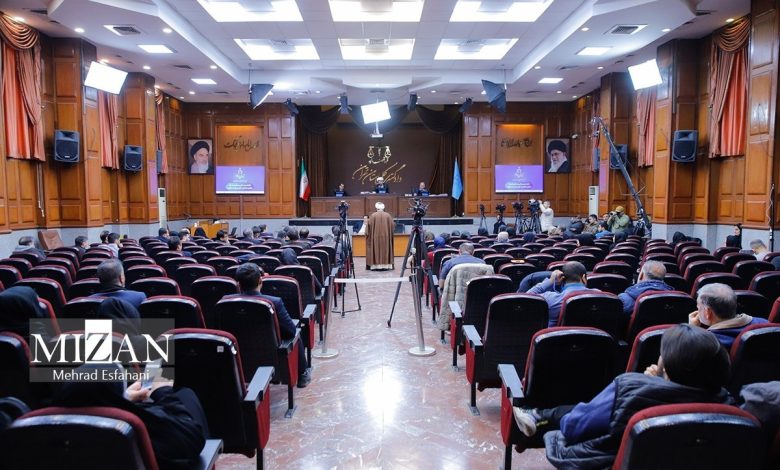
According to Mizan News Agency, the 53rd court session to investigate the charges against 104 members of the People’s Mojahedin Organization (PMOI), also known as the MKO TERRORIST GROUP, as well as the nature of this organization as a legal entity, is being held publicly on Tuesday (3 February 2026) in Branch 11 of the Criminal Court of a Tehran province, presided over by Judge Amirreza Dehghani and court advisors Morteza Turk and Amin Nasseri, in the presence of a minister representing the prosecutor, the families of the martyrs and their lawyers, as well as the lawyers of the defendants in the Imam Khomeini Judicial Complex.


At the beginning of the session, Judge Dehghani stated: “The present trial is being held in Branch 11 of Tehran Criminal Court No. 1 in order to hear the indictment received from the Tehran General and Revolutionary Prosecutor’s Office to hear the charges against 104 defendants, members of the central cadre and the legal entity of the MEK.”
Counter-revolutionary media attempts to spread false news about the deaths of 2 medical students at Tehran University/ Head of Tehran Criminal Affairs Prosecutor’s Office: No evidence of a crime has been found/ Presence of used bottles of alcoholic beverages at the site where the bodies were discovered
Next, the plaintiff’s lawyer appeared on the stand.
Explaining the criminal nature of the terrorist group, the plaintiff’s lawyer emphasized in line with the clients’ complaint: “This organization, with a track record of martyrdom of more than seventeen thousand Iranian citizens, has always killed innocent people, including youth and children, and has even taken pride in these actions.”
Referring to one of the clear examples of these crimes and the Forough Javidan operation, he said: “In that operation, after accepting the resolution and establishing a ceasefire, Massoud Rajavi, with the support of Saddam Hussein, resorted to military action and the killing of the Iranian people again for the survival of the organization, because the life of this organization has been based on terrorist operations and the creation of fear and violence. In this operation, mass killings, heinous murders, the destruction of cities and villages, the displacement of civilians, the burning of hospitals, houses, and the destruction of civilian property occurred, which are only some of their crimes.”
Regarding the criminal liability of the defendants’ involved elements, the lawyer said: “In general, they can be divided into several categories: individuals who were in charge of supervising and commanding the terrorist operations, middle commanders and officials of the axes, armed members and operational cadres of battalions and companies, as well as individuals who, although they were not directly present at the scene of the operations, played an effective role in the realization of these crimes by supporting, planning, making decisions, and facilitating criminal actions; therefore, in this case, we are not dealing with a simple group of criminals committing a few limited crimes, but rather with a coherent, structured, and organized terrorist organization.”
Masoud Maddah, the plaintiff’s lawyer, said: “In the organizational chart of the MKO TERRORIST GROUP, which is described in the Mujahid magazine, issue 252, pages 45 to 62, Masoud Rajavi, the defendant in the second row of the case, is introduced as the leader, and Maryam Rajavi, the defendant in the third row of the case, is introduced as the first official of the organization. For example, Ali Zarkesh is introduced as the military and political commander.”
He added: “They name a list of approximately 19 members of the organization, who are members of the organization’s political office, and their job is to carry out political work, but why is it said that they are a terrorist group? Because the same person who is also active in political discussions or who was involved in financing, according to the testimony that the witnesses present at this meeting also acknowledged, no one would leave Ashraf unless they were armed; therefore, they are an armed terrorist team.”
Maddah, citing an example, said: Mahmoud Ataei, the defendant in case number 26, who works in the organization’s political office and the organization itself introduces this person as an active person in the political office, is in charge of the Tehran axis in Operation Forough Javidan, where he becomes the commander of the 13th brigade and is responsible for capturing the city of Tehran and enters the conflict. Another person, such as Mehdi Baraei, was in the same position.
He continued: “They also name some members as members of the organization’s central cadre and some as members of the organization’s executive members and assign them various tasks, but when it comes to operations, they are all armed and oversee these crimes. Finally, the fourth category was people who became members of the MKO TERRORIST GROUP after this operation and after the organization’s terrorist actions.”
Hojjat al-Islam wal-Muslimeen Maddah stated: In the last session, I presented some information regarding the criminal liability of these five groups separately, and I explained in detail to the court the appointment of the three crimes of corruption on earth, war, and rebellion, by applying the material and moral elements to the defendants in the case and the members who played a serious role in Operation Forough Javidan.
Further, at the request of the plaintiff’s lawyer, a report of the material acts committed by each member and leader of the MKO TERRORIST GROUP was presented in the court in the form of a PowerPoint file. In this file, the crimes of each member based on rebellion, war against the land, and corruption on earth were examined separately.
Regarding this file, Maddah, the lawyer, said: “Based on the information available in this file, Massoud Rajavi, the second defendant in the case, was the founder and founder of the MKO TERRORIST GROUP and the Anti-People’s Army to commit murder and massacre of people and mobilize forces to act against the foundation of the system and issue orders for terrorist attacks, cooperate with the Iraqi Baath regime, lead and guide operational teams, procure and equip military equipment, issue orders for military attacks and participate in terrorist operations and issue orders for armed war both in the 1960s and in the organization’s military actions. These accusations were also raised in the indictment, but today I will also explain the material elements of the crimes that each of the defendants committed in court.”
In explaining the material elements of these crimes, he added: “Masud Rajavi collaborated with Saddam Hussein and the Baath regime during the imposed 8-year war. So far, more than 194 documents have been discovered indicating that Maryam and Masoud Rajavi and many members of the central cadre collaborated with Iraqi intelligence and Saddam Hussein to receive funding, receive equipment, and prepare operational plans.”
Lawyer continued: “Procuring military equipment and preparing attack plans in cooperation with Iraqi intelligence, organizing and training forces, commanding and directing forces to carry out operations, and leading forces to direct attacks on cities and villages are among other material elements of these crimes. According to the statements of witnesses present in previous court hearings, Massoud and Maryam Rajavi and several other defendants arrived in the operational area by helicopter; that is, an armed attack on the country with the intention of aggression, killing, and occupying parts of the country.”
Maddah stated that the command and control of the operations and the issuance of orders to carry out the operations were with Massoud Rajavi, and said: “Rajavi was the mastermind behind these crimes. Rajavi was persuading the forces for military operations. Witnesses testified in court that Massoud Rajavi gathered all the members to carry out the Forough Javidan operation and spoke for them. From this it becomes clear that the survival and life of the MKO TERRORIST GROUP organization is based on crimes and killings.”
He continued: “Cooperation with the Iraqi Baath regime during wartime, which is an example of cooperation with hostile states, is another of the organization’s actions.”
The plaintiff’s lawyer added: “The publications attributed to the first-degree defendant, the testimony of witnesses present in court, and the military documents presented are among the reasons for attributing the charges to the second-degree defendant.”
He continued by discussing the role and position of the third defendant, Maryam Rajavi, as the deputy commander of the so-called “Liberator” army, and said: “According to the available documents, she had a direct and effective role in guiding, controlling, and directing teams, issuing operational orders, and ordering military attacks.” The clip shown in court also shows that the aforementioned person personally issued the order to start firing during the Aftab and Chelcheragh operations and began the operation by repeating the command to fire. These images were published and proudly republished by the organization’s own official media. Her field participation in the Aftab, Chelcheragh, and Forough Javidan operations is also proven.
Maddah also said: Among the actions and behaviors attributed to him as the deputy commander-in-chief, we can mention cooperation and assistance in organizing, training, and preparing the forces, participating in command during the attack and issuing terrorist orders, being present in the command room alongside Massoud Rajavi and directly leading the operational teams, leading the forces in attacks on cities and villages, cooperating with the Iraqi regime’s intelligence, providing military equipment and logistical support, and also being armed in conflict areas.
He said: “In accordance with the organizational duties of the organization itself, Maryam Rajavi has been responsible for extensive headquarters and executive responsibilities, including supervising operational headquarters, intelligence, logistics and training units, establishing coordination between different departments, summarizing and reporting to the command, controlling the implementation of issued orders, replacing the commander-in-chief in cases of lack of access, and ultimately managing operations and tactical support. Accordingly, the direction and management of all military and terrorist operations, providing support and organizing forces were practically carried out under her direct responsibility.”
lawyer said: “The documentation attributing these responsibilities is also numerous and comprehensive, and includes films and reports published by the organization’s official media, internal publications, documents provided by security and military institutions, as well as the testimony of witnesses and defected members present at the court hearing, all of which indicate the defendant’s active and effective role in planning, directing, and executing terrorist acts.”
Maddah stated: According to what is stated in the indictment, Mehdi Abrishamchi, the fourth defendant, in addition to being one of the people responsible for engineering operations and assassinations in the 1960s or being responsible for supporting armed teams in the 1960s, was the commander of the headquarters and deputy commander of the headquarters of the forces involved in the operations “Chelcheragh Aftab” and “Forough Javidan.”
He added: “In the next slide, I will explain to the court the material elements of the crime attributed to this person, and that he was responsible for support, and what exactly he did. He was responsible for supplying and distributing food, fuel, ammunition, clothing, and equipment needed by those who killed people, preparing and maintaining vehicles, machinery, and organizational and armored weapons, transporting troops and equipment between operational areas, technical support in the fields of telecommunications, medicine, and field repairs, managing warehouses and coordinating with headquarters, and assessing future needs for terrorist operations, all of which were part of his duties.”
Maddah noted: The aforementioned person was responsible for the command headquarters and in this position, he compiled operational plans and executive instructions that were communicated by the commander or deputy commander of this terrorist anti-people’s army, conducted the overall direction of the forces according to the communicated mission, supervised the implementation of operations, communicated directly with higher headquarters, coordinated between various intelligence departments, and performed other duties.
He said: “That he was in charge of the intelligence headquarters and what responsibilities did he have as a result? It should be said that in this position, he was involved in collecting information from technical, human, and electronic field sources.”
Maddah emphasized: “One of the things they did, and I will present documents in detail in the role of the organization during the imposed war in future sessions of the court service, was that they eavesdropped during the imposed war and by revealing Iranian operations to Saddam, they led to the defeat of their own forces and ultimately led to the killing of fellow countrymen at the hands of the accursed Saddam.”
He added: “The geographical location and movements of the area of operations, preparing intelligence reports for the command headquarters, examining the weaknesses and strengths of the organization’s forces and the enemy (the enemy means the Iranian people who are killing them), identifying targets and assessing risks before and during operations, setting up and managing anti-espionage encryption and eavesdropping systems are among the things they did.”
Maddah clarified: He was the deputy head of the force headquarters in operations Chelcheragh, Aftab and Forough Javidan, and I presented it to the court in the next slide. His duties were to carry out tactical planning and implement operational plans in the field, to provide immediate reports on the field situation to the General Command, and to obtain assignments.
He said: “Other duties include maintaining official readiness and coordination between frontline teams, making quick decisions in unpredictable situations, managing the operational area, communicating with command, support and information during the mission, directing official, ship, protection and relief units. I also presented the responsibilities of the other defendants in detail in the bill to the High Authority.”
The plaintiffs’ lawyer continued: “With regard to Massoud Rajavi and other leaders of this organization, it should be clarified that the set of acts and material elements of the attributed crimes, alone and even by examining only one specific example, namely Operation Forough Javidan, is sufficient to prove complicity and participation in the widespread killing of people, as well as complicity in causing extensive damage to the physical integrity of citizens. This operation was designed and implemented in a completely organized, coherent, ideological manner, and with the aim of confronting the foundation of the system and the intention to overthrow it; characteristics that alone are sufficient to qualify for the criminal title of war and corruption on earth. Similarly, the legislator in the 1982 law also criminalized such armed and organized actions under these titles; therefore, all individuals who played a role in Operation Forough Javidan within the framework of those five specific categories will be subject to these criminal titles.”
He said: “None of the perpetrators and commanders can evade responsibility by simply claiming that they ordered the attack or did not intend to kill civilians, because they knew that such crimes could occur, and these results would typically and conventionally result from their actions. When an armed attack is launched on cities and residential areas, the occurrence of killing, destruction, and harm to civilians is completely predictable, and in this case, the defendants played a direct role in decision-making, directing, and controlling the forces, and deliberately pursued the operation.” In addition, according to the testimony of the witnesses present at the hearing, Massoud Rajavi explicitly ordered the forces to kill protesters if the people opposed them, which clearly indicates the intention and will to commit a crime.
The plaintiff’s lawyer said: “The claim of following the order of a superior or being an officer does not absolve the responsibility; firstly, such an order lacks legal and legitimate characteristics and is not considered a legal order and cannot absolve the responsibility. Secondly, even the claim of coercion is not accepted in such crimes; because according to Articles 375 onwards of the Islamic Penal Code approved in 1392, coercion in killing and killing another does not absolve the responsibility of the officer. Obviously, the defendants who were themselves in the position of middle commanders and heads of operations, in principle, do not have the possibility of citing coercion either. Accordingly, the criminal responsibility of the officers, deputies and commanders of these crimes is established.”
Maddah stated: The defendants can never claim that they did not intend to kill people because, in clauses (b) and (d) of Article 290 of the Islamic Penal Code, there was awareness and consideration that the acts committed by these defendants were typically lethal. No one can claim that I attacked ordinary people with tanks, mortars and missiles, but I did not intend to kill them. If someone claims that these had a political goal, their claim is not accepted because no law in the world accepts mass killings and brutal murders, burning bodies, attacking hospitals, killing the wounded, attacking the maternity ward of a hospital, and killing a newborn baby in the mother’s arms with the claim of a political goal.
He continued: “Nowhere in the world can it be claimed that these actions were political. They cannot claim that they attacked military centers and had nothing to do with civilians. Even if we do not intend to cause widespread disruption and widespread crimes against the physical integrity of individuals, if we do something that results in widespread disruption and crimes against the physical integrity of individuals, according to the law, it is considered corruption on earth. While witnesses repeatedly stated in court that these crimes were committed against the people, and Massoud Rajavi asked members of the organization to kill people even if the people stood up to them.”
“A military attack will certainly create a lot of fear and terror in society,” said Shakat’s lawyer. “Someone who takes up arms with the intention of creating insecurity and terror, and kills military forces, will certainly create more fear and terror than if he killed ordinary people.”
Maddah continued: “The structure, functioning, and approach of this terrorist organization are such that its crimes were not sporadic and limited to a specific decade, but have continued in a continuous and organized manner until today. We are not dealing with an instantaneous crime or an isolated operation, but rather with a series of continuous and chain crimes. Therefore, even the later members of the organization, those who were not present in Operation Forough Javidan or the military operations of the 1960s, have also contributed to the continuation of its terrorist actions by simply being a member and active in this organization and are subject to criminal liability.”
He said: “The organization’s continued terrorist operations confirm that this group was formed primarily to commit crimes and its nature has not changed. Continuous cooperation with hostile governments and enemies of the Iranian nation – including cooperation with the Iraqi Baath regime, and at other times with other regional and trans-regional enemies, as well as the continuation of subversive and terrorist acts inside the country – show that this organization has always been in the ranks of those opposed to national security and wherever there is hostility against the Iranian people, the name of this organization is also seen alongside it.”
The lawyer said: “There is no change in approach or declaration of innocence from the criminal past in the behavior of the latter members; on the contrary, they also explicitly support and defend the past and current actions of the organization. Therefore, when the nature of a group has been formed from the beginning based on criminal and armed acts and this process continues, the mere act of membership, propaganda, financing or accepting responsibility in its structure is itself criminal. In the first way, individuals who are placed in positions of command and central responsibilities can, depending on the case, be subject to titles such as aiding and abetting widespread insecurity and corruption on earth.”
He continued: “There are also media documents confirming the organization’s continued terrorist activities. These include clips presented to the court in which the second and third defendants and some others are directing forces in the command room of Operation Forough Javidan. Also, images and reports from less than a month and a half ago show that the media affiliated with this organization encourage and proudly introduce armed individuals known as rebel groups for violent acts and killings, which indicates the continuation of the same terrorist policy of the past. Accordingly, in order to complete the investigation, inquiring from security institutions about the role of these groups and the continuation of the organization’s actions can be effective in clarifying the dimensions of its criminal activity.”
he stated: “This clip was published on November 13, 1404 by the organization’s official media. In this clip, this group has promised to kill and revolt the people. This clip confirms that we are facing a group whose foundation is criminal and which continues to pursue its criminal goals to this day.”
Samad Eskandari, one of the defected members, then took the stand and said: “I was a member of the organization for 17 years. The MKO TERRORIST GROUP played a direct role in creating chaos, setting fire to banks and offices, and attacking security forces during the events of June 20, 1988. These actions resulted in the deaths and injuries of innocent people.”
He said: “The organization, led by Rajavi and connected with America and Israel, was leading the unrest in an organized and indirect manner. The same pattern and scenario has been repeated in the unrest of recent years. The organization does not have a popular base and its internal propaganda is false. After the separation in 2005, when I escaped and came to Iran, I realized that most people do not even know the name of the organization.”
Eskandari said: “Recent events reminded me of the riots and seditions of June 20, 1988, a policy based on which the organization was trying to show its foreign masters, including the United States and Israel, that it had operational power. Although the command and direction of these actions was often carried out indirectly, the role of the organization’s leadership in instigating and organizing these events is quite clear, and people’s lives were not important to them.”
This defected member of the organization stated: In 2014, Massoud Rajavi established a political office centered around Mehdi Abrishamchi, under the pseudonym Sharif. After he had an illicit relationship with Mehdi Abrishamchi’s wife and managed to marry her, protests arose at the highest levels of the organization, and Rajavi was forced to consider a center for the organization.
He added: “The Great Husseiniyeh of Zanjan is well-known in the country. The family of Saeed Mohsen, who was one of the founders of the MKO TERRORIST GROUP, lives in Zanjan. They are still a traditional and religious family who oppose their son’s actions. I spoke to one of his family members at the Great Husseiniyeh of Zanjan and he said that we are committed to the Islamic Republic to the end of our lives.”
This defected member of the MKO TERRORIST GROUP stated: Rajavi continued to discuss centralization and would place some individuals in whom he had complete trust at the center of the organization. The main individuals in this centralization were Mehdi Abrishamchi, Abbas Davari, Mohammad Seyed al-Muhaddisdin, Ebrahim Zakeri, Mehdi Taghavi, Mahmoud Ataei, Abolghasem Rezaei, Azra Alavi, Fahimeh Arvani, Mahvash Sepehri, Zohreh Akhyani, Dehim, Soheila Sabri, and Mahboobeh Jamshidi.
Eskandari continued: “Among the names of the defendants brought up in court, the names of some criminals are not there. Mahbouba Jamshidi, alias Azar, was the commander of the Faezeh tactical base in Kuk, which, due to its proximity to the Mehran border, actively trained assassination teams and personally led these teams and sent people inside the country to assassinate personalities. I myself witnessed Mahbouba justifying, training, and sending people inside the country to carry out terrorist operations. Her name is not among the names of the defendants in court.”
This defected member of the MEK said: “Given my knowledge of the MEK structure and the media, I would like to talk about the image-building and role of the central cadre of the Leadership Council and military aid.”
He said: “It may be a bit strange, but when I was a child during the Shah’s reign, the television series “Milijak Darbar” was broadcast. Rajavi’s personality and identity are very similar to this “Milijak Darbar”, because while he was in a SAVAK prison, feeling threatened by execution, he sold out all his like-minded people and revealed to SAVAK the places where they were hiding so that he himself could survive.”
Eskandari continued: When he was released from prison in the anti-monarchy uprising, he resorted to the epic events of Khordad and armed war in order to usurp sovereignty. When he fled to Paris dressed as a woman, he was waving at his foreign masters in France, so that he could create a position as a political alternative by serving them. When the field became narrow for him and the story of South Africa came up and the government expelled them for whatever reason and sent them to African countries, he felt in danger and secretly met with the Iraqi Prime Minister in Paris and signed a peace treaty with this person.
He said: “When Rajavi feels that a master is being lost, he tries to secretly sign a peace treaty with the Iraqi Prime Minister and then comes to Iraq. They believed that the war was not imposed and that it was launched by the Islamic Republic and that the war was not just. Rajavi was insinuating this.”
He said: “Their strategy for survival was to create war and export terrorism. One of Rajavi’s policies was that the Islamic Republic had to go, and by exporting the crisis of war, terrorism, and internal repression, this move had to happen. The basis of this peace treaty with the Iraqi Prime Minister was that Iraq had not started the war, despite the fact that the Supreme Security Council had mentioned this issue in its resolution. Of course, by doing so, Rajavi was legitimizing his espionage and betrayal.”
The judge said: “Even if someone is a representative of the Iranian people or not, should they write a peace treaty with the enemy of the Iranian people?”
Eskandari said: Yes. Rajavi did this as easily as drinking water. For example, Rajavi fled to France with Bani Sadr. When Massoud Rajavi went to Iraq and went to military bases and started military operations, Bani Sadr took a position as someone who was against this country and said: I am also against the Islamic Republic, but carrying out military action against the country is treason.
He said: “There is an audio file of Bani Sadr in which he said that Rajavi is like the courtier. When Saddam was overthrown, he fled to the arms of America in fear. We witnessed programs held as “Sham Jamil” where the Americans were present before the members were present.”
Eskandari said: “They were saying that we should embrace America, since we lost Iraq. After that, in 2016, since the headquarters of the Zionist regime’s ill-fated embassy is located in Albania, they were secretly in contact with the embassy of this regime. Rajavi has such a personality and he was a man of a thousand faces.”
This eyewitness recalled: The Leadership Council was really a formality, because in the early 1970s, Saddam Hussein was afraid of the failures of the MKO TERRORIST GROUP in military operations in the country and the consequences of the killing of civilians by the organization, and he feared that Iran would want to respond to these operations. At that time, Mehdi Abrishamchi was responsible for relations and provided the Baath regime with military information, the location of cities, and other sensitive information about the country.
He continued: “The Iraqi intelligence chief had direct contact with Mehdi Abrishemchi and received information from him. In my opinion, Abrishemchi is more guilty and hypocritical than Rajavi. He committed many crimes against the Iranian people and even members of the organization. Abrishemchi was responsible for torturing and eliminating dissidents and protesters in the organization.”
This defected member of the MKO TERRORIST GROUP said: Because Saddam was afraid that Iran would retaliate for these operations of the MKO TERRORIST GROUP, he did not allow them to operate for years and they were isolated. For this reason, Rajavi implemented a new tactic, which was to form a leadership council with the presence of women. The organization’s strategy was that Rajavi was the all-rounder of the organization. Because the organization needed a new arrangement that would entertain the members and prevent the members from having the opportunity to think and reflect on the goals and promises they had made, they established the Central Council. Why were women used in this central council? Because most of these women did not have much experience in membership of the organization and their presence was a kind of formality.
He clarified: “For many members of the organization, the question was why Maryam Rajavi should be at the head of the organization? Rajavi wanted exactly that. He wanted to divert the members’ minds to these side issues so that they would not have time to think and would not have to deal with Massoud himself.”
He continued: “Unfortunately, women were greatly harmed in this structure and were oppressed more than in other parts of the world, because their beliefs were betrayed. What calamities did Massoud Rajavi bring upon these women and their children with the dance of liberation and the title of the Leadership Council? All their beliefs, world, body, and soul were conquered and they were led to destruction. By putting these women in charge, Rajavi is somehow winning their hearts.”
He said: “When I wanted to see a picture of my mother, father or sister, I had to report it, and this was forbidden. Once I saw my mother in a dream and I unintentionally told the commander this, I missed my mother. Three days later they said, ‘Come and tell me that your mother is a barrier between you and the leadership.'”
He said: “The Mojahedin Organization was a picture of corruption and betrayal; betrayal of God, betrayal of the people, and betrayal of the country. The reality is that all these people must be held accountable. I myself am a protester; people like Mahboob Jamshid Azar, Qudrat Haidari, Rahman Haidari, and others whose names are mentioned have committed crimes and must be tried, and their names are not on this list.”
Eskandari said: “In recent events, the MKO committed the worst betrayals and even raised the slogan of dividing the country. Even now, before they reach Iran, they are engaged in conflict with other groups abroad; if they enter Iran, it is not known what they will do. These are traitors, and I consider it my duty to expose the nature of these corrupt and violent movements wherever there is a platform.”
He said: “Regarding their internal relations and structure, it should also be said that the decisions were unilateral. The commander gave orders and the troops only carried them out. The plan for operations was communicated from above; for example, they said that such and such an operation should be carried out and the troops acted without authority. Some commanders were directly connected to Rajavi and had no will of their own.”
Samad Eskandari, a dissident member of the MKO TERRORIST GROUP, stated: “Massaud Rajavi, as the commander-in-chief of the army, gave orders and these orders had to be communicated blindly. There was a branch or a pyramid that had to announce these orders to the commanders and squads in their own headquarters. These orders would eventually overflow to the operational teams that they had prepared; that is, the teams were hand-picked. All of this was done by the hierarchy that had been set up and the relationship was very clear and there was no compromise in this regard.”
He added: Rajavi was an introverted, egotistical, and self-centered person, and he would say that even if his orders were wrong or if many people were killed, the order must be carried out. He turned Mehdi Tehrani, the commander of a very large operation who was standing in front of an order from him, into an addict. I heard from members that they made him an addict and then he died tragically. Why? Because Rajavi said in front of him that he did not accept the ideological revolution, and in my opinion, who entered the phase of this organization since the time of the Shah, Maryam Rajavi is not worthy of being a leader. They would not let her sleep next to us or eat in the dining hall, because they were afraid that she would affect others. They would keep her in a barracks. In short, if someone did not blindly obey Rajavi’s order, they were doomed to perish.
Eskandari said: “The terrible earthquake in Rudbar and Manjil in 1989, many of us were involved in this incident and were worried about our families. It was not even possible to contact our families, and after a few days we found out that neighbors had announced that family members were missing. Later we found out that some organizational videos had been recorded to show the situation of the families, many of those who fled in 2005 had really lost their families.”
He said: “Decision-making in the organization was not independent, all orders were issued based on the personal will of Massoud Rajavi, and the commanders and members were only forced to obey and had no independent will. Even the formation of the Leadership Council was not influenced by the will of individuals. Rajavi never paid attention to the independent opinions of the members, all matters were carried out based on centralized decisions and orders from above.”
Eskandari, a defected member of the MEK, continued his statements: Ghorbanali Torabi and Parviz Rahmati were being tried by Mohammad Seyed al-Muhaddisdin, the fourteenth defendant in this case, and the judge at the time was Mahvash Sepehri. These people were told that they had to choose between the MEK and the IRGC, and otherwise, it was said that if you are not one of us and you are an IRGC member, you will be executed. These people were also threatened with Abu Ghraib prison.
He added: Mehdi Abrishamchi and Mohammad Seyed al-Muhaddisdin accompanied these individuals to their solitary confinement on the eastern side of Camp Ashraf, and these individuals personally tortured the prisoners.
Eskandari continued: Mohammad Seyed al-Muhaddisdin, the fourteenth defendant, was directly involved and present in Operation Pearl, and at that time, while reviewing the situation, he was conveying Massoud Rajavi’s messages to the commanders.
This defected member of the MEK continued to explain the structure of the political headquarters and said: “The MEK had formed several headquarters, including a political headquarters, a social headquarters, an internal headquarters, and a military branch. The responsibility for the political headquarters was on Mohammad Seyyed al-Muhaddisdin, who was also responsible for establishing foreign relations. Politically, the organization justified itself by saying that since the Mersad operation took place after the ceasefire, a statement was issued at that time stating that this war was not our war, but the war of the Islamic Republic’s sovereignty, and that the operations they carried out were carried out in order to overthrow the sovereignty and bring the people to their demands, which they called true democracy.”
He added: “Massaud Rajavi had announced to Mohammad Seyed al-Muhaddisin in a meeting that your responsibility in America, Europe, and especially in Germany is to convince them to defend and support us so that we can advance our goals, and you must justify the fact that this operation was not a failure but a victory. The senators who have recently appeared among them are all led by Mohammad Seyed al-Muhaddisin and are paid dollars to support the Mujahedin organization.”
Continuing the session, the plaintiff’s lawyer also stated: “In his statements, the witness has introduced a new person named Mahmoud Jamshidi, who was the commander of the Faezeh headquarters and a member of the central headquarters, who prepared assassination teams for terrorist acts inside the country, and who also played a serious role in these military operations.”
Mohammadi, the defendants’ lawyer, appeared on the stand and said: “Out of 53 sessions, we have only been given time for 3 sessions.” Today, the plaintiffs’ lawyer divided the defendants into several groups, and we are worried that with this classification, we will also be considered among the defendants.
The judge said: “Which group do you belong to that you were considered one of the defendants?”
The judge said: “The defendants’ lawyers are present in the hearing and are obliged to defend their clients based on the court’s order and the legal obligation of the legal profession. The presence and legal defense of the lawyer for the client will not affect the nature of the crime or the individual’s responsibility; just as a lawyer’s defense of a murderer, thief, or financial suspect does not incriminate the lawyer himself.”
The lawyer for the defendants in the case continued: “Given that a character file is mandatory for the defendants according to the law, I request that this action be taken for my clients.”
The judge stated: “We will definitely file a character case for the defendants and invite relevant experts to the court to express their expert opinions on this matter.”
He continued: “Rajavi used to say that anyone who wanted to get close to me had to pass through Maryam’s channel and somehow melt into Maryam. They were suppressing the members.”
The judge then asked the eyewitness about defendant number 114 and the members of the central cadre, and the eyewitness replied: I know him very well. He was one of the most evil and torturer elements in the organization and they had given him the nickname “Hassan Shammar”. They held ideological classes for those they sent to terrorist operations and said that if you were caught, you should carry out ISIS activities. They had four grenades that if they were discovered, they would have to blow themselves up. The members were not forced to do their actions, but they did these things with their beliefs and convictions.
Farkhani, the legal representative of the Islamic Republic of Iran’s army, explained the dimensions of the Iraqi Baath regime’s cooperation with the MKO TERRORIST GROUP, stating: “The MKO TERRORIST GROUP’s operations were welcomed by Saddam Hussein’s first deputy, defense minister, and interior minister, and the reason for the MKO TERRORIST GROUP’s departure to Iraq was said to be to provide more suitable grounds for the organization’s new plans. The real reason for this was the MKO TERRORIST GROUP’s cooperation with the Iraqi Baath regime to fight against Iran.”
He added: “The formation of the National Liberation Army had a significant impact on the training, equipment, and activities of the MKO TERRORIST GROUP. The activities of this organization can be divided into two periods: before the formation of the Liberation Army and after the formation of the Liberation Army.”
The legal representative of the Islamic Republic of Iran Army continued: In June 1987, on the occasion of the anniversary of the first armed demonstration of the MKO TERRORIST GROUP against the Islamic Republic of Iran that had taken place in 1987, Massoud Rajavi issued a decree on the formation or establishment of the National Liberation Army on the eve of June 20. With the issuance of this decree, the actions and nature of the activities of this organization changed.
He clarified: Before the formation of the Liberation Army, the operations and military actions of the MKO TERRORIST GROUP were mainly carried out in the form of irregular guerrilla operations at the levels of detachments, companies and battalions, and included raids on border bases, suicide operations and assassinations of individuals and groups. However, after the formation of the Liberation Army and the support of the Iraqi Baath regime, the operational format of this organization changed and became more coherent, so that battalions, brigades and divisions were formed and the operations turned from guerrilla and unit attacks into organized and regular operations.
Referring to the changes made in the field of education, Farkhani continued, saying: “The establishment of the Liberation Army also had a serious impact on the education sector. Before that, the training mainly included assassination, setting places on fire, working with listening and spying devices, training in assault operations and robbery, making explosives, creating explosions, working with knives, machetes and other cold weapons, terrorist attacks, guerrilla warfare, pursuing subjects and mortar fire. However, after the formation of the Liberation Army, the training became more coherent, structured and organized.”
He added: With the support of the Iraqi Baath Army, numerous barracks and headquarters were established, including the Ashraf barracks, the Hanif barracks, the Habib barracks, the Faiza barracks, the Khalid barracks in Kirkuk, the Tariq barracks, the Andalusia barracks, the Anzali barracks, and other barracks. The necessary training was provided to the personnel of this organization by Iraqi training officers in infantry and mechanized platoons, which included working with tanks, personnel carriers, and engineering, support, equipment, repair and maintenance, and even aviation.
The legal representative of the Islamic Republic of Iran’s army noted: Before settling in the fold of the Iraqi Baath regime, the training department of the MKO TERRORIST GROUP was mainly based on the use of soldiers or non-commissioned officers of the Islamic Republic of Iran’s army who had been taken prisoner and forced to transfer their training to other members of the organization. However, after the formation of the National Liberation Army, the Iraqi Baath regime provided the organization with more extensive support, especially in the field of training.
He added in conclusion: In the late 1960s, the MKO TERRORIST GROUP established an educational center called Forough Javidan University, which, although not a university in the strict sense of the word, was, as an academic educational environment, responsible for providing basic, higher, and professional education and equipping the organization’s members with various types of specialized training.
“Many of those who were recruited were actually soldiers who had no other choice; they either had to accept what was said to them, whether willingly or under duress, or they faced an unknown fate,” Farkhani said. “A large number of soldiers joined the organization in exactly the same way.”
He continued: “They were asked why you didn’t leave? The answer was that they had told us: You are only participating in this operation now, you will carry out one operation and then you can return to Iran. But after the operation was completed, we were not allowed to return. When they protested why we could not return, they said: Now you are part of the organization. If you set foot in Iran, you will be executed by Iranian intelligence. You know, if you want to go.”
He added: “The conditions were designed in such a way that the individual, who was often a simple soldier, would be caught up in the action and practically forced to come to terms with the organization’s conditions in order to save his own life.”
The legal representative of the Islamic Republic of Iran’s army said: “They were trained by personnel and officers of the Iraqi Baath regime. After they were trained, they independently trained people. In terms of military structure, their organization in the human resources department consisted of 3 groups.”
Farkhani emphasized: “They had a group of core forces and were the core of the Liberation Army, and as witnesses suggest, these were the people who were at the top of the pyramid and were privy to the core of the organization. They were at a good level in terms of education and work experience, and their training was better and more complete than other people.”
He said: “One of the actions of the organization that violated international humanitarian law was to use the people they captured as human shields. In arranging the forces for the attack, the front line of attack was first placed by those who had received less training, and second were those whose presence was not very important to the organization, and these people were called the black people of the division.”
Farkhani also emphasized: “People who were said to have been properly trained fought until the last moment and when their ammunition ran out, they committed suicide with grenades or swallowed cyanide and refused to be captured. These people were so brainwashed that they considered suicide as a last resort, and this was in line with their unquestioning obedience to Rajavi, who had ordered them to do so.”
He said: “There was another group of forces that were gathered from other countries, especially Europe, as needed, through various calls, and they went to Iraq and participated in operations. In Operation Forough Javidan, a call was made and people were recruited.”
Farkhani, the legal representative of the Islamic Republic of Iran’s army, continued his statements by describing the military equipment of the MKO TERRORIST GROUP and said: “The major items, equipment, and heavy equipment of the MKO TERRORIST GROUP that were used for operations against the Islamic Republic of Iran included a set of heavy military equipment, which I consider necessary to present the documentation for these statements before explaining them.”
He added: “The documentation for these materials includes reports from the operations and intelligence units of the Islamic Republic of Iran’s army, official publications of the MKO TERRORIST GROUP, including the Mujahid magazine, materials published in systems and media affiliated with this organization, including the Simaya Mujahid television network, statements and confessions of individuals arrested from the MKO TERRORIST GROUP in various operations obtained during interrogations, Rajavi’s statements before the Forough Javidan operation, and other sources of information on the basis of which these statistics and information are presented to the esteemed court.”
The legal representative of the Islamic Republic of Iran’s army continued: “Based on these documents, the MKO TERRORIST GROUP at the time in question had 9 helicopters, including 6 Mi-6 helicopters and 3 Me-530 helicopters, which were provided to the organization by the Iraqi Baathist regime. The organization also had 125 T-55 tanks with Dushka turrets and 36 Brazilian Cascavel tanks, and the Cascavel tanks were used the most in Operation Forough Javidan.”
He added: “In Operation Forough Javidan, due to the nature of the operation, which was defined as simply surveying the route, the MKO TERRORIST GROUP used mostly wheeled tanks, while in Operations Chelcheragh and Aftab and other operations, they used sand tanks because the combat scenes in those operations were sandy and sandy and wheeled tanks could not navigate. Also, 9 tanks made in England were at the disposal of the organization, which were among the tanks that the Iraqi Baath regime had captured from the Islamic Republic of Iran and then handed over to the MKO TERRORIST GROUP.”
Referring to the lack of trained manpower compared to the volume of equipment, he said: “In Operation Forough Javidan, the MKO TERRORIST GROUP practically brought everything it had to the field, but considering the volume of equipment mentioned, this organization did not have the trained force to match it. For this reason, many people who had either received minimal training or had no military training at all were used solely to direct equipment, create vehicle columns, and instill morale in the forces, to the point where even drivers of ordinary vehicles were used as personnel carriers or tank drivers to move this volume of equipment.”
The legal representative of the Islamic Republic of Iran Army continued, referring to the role of martyr Lieutenant General Ali Sayyad Shirazi, and stated: “The great martyr Sayyad Shirazi, upon observing this huge column of equipment, while they were deployed by helicopter above the vehicle column before reaching the strait, was surprised by the volume of equipment and the disorder of their military structure, and emphasized that such a gathering of equipment without a coherent military structure created an opportunity for decisive confrontation.”
He added: “In the operation, the forces of the Islamic Republic of Iran were able to deal with the elements of the MKO TERRORIST GROUP in a concentrated manner, whereas before, the forces had to identify and destroy the MKO TERRORIST GROUP in a scattered and one-by-one manner in Tehran and other parts of the country.”
Farkhani also referred to the media reaction of the MKO TERRORIST GROUP after the martyrdom of Martyr Sayyad Shirazi and said: Martyr Lieutenant General Sayyad Shirazi was martyred at 6:30 in the morning, and only a few hours later, at 12 noon, the Mujahid magazine covered the issue with a bold headline, indicating the full readiness of the MKO TERRORIST GROUP media unit to exploit this terrorist act for propaganda purposes, as publishing such high-volume material, layout, typing, and editing, under normal circumstances, requires considerable time.
He added in conclusion: “This shows that the media apparatus of the MKO TERRORIST GROUP was prepared in advance and the relevant content was published immediately after this terrorist act. Also, television interviews and additional materials were published at the same time. After that, in response to these actions, the armed forces of the Islamic Republic of Iran launched a missile attack on the positions of this organization in Iraq, which led to the death of a large number of elements of this group.”
Regarding the character file of the defendants, the judge said: “The court has issued an order to file the character file of the defendants. The filing of this file is very important in issuing a verdict.”
Parviz Bagheri, a defected member of the MKO terrorist group and one of the people present in Operation Forough Javidan, continued: “Someone offered me a job and I was recruited into the organization with their promise. They promised me a job.”
This defected member of the organization said: “I had reached a point where I had to return.”
The judge said: “You were in the organization for 12 years.”
Bagheri replied: Yes, I was in the defense at Camp Ashraf.
Bagheri, a defected member of the Mujahedin Organization, said: “I had no possibility of leaving or returning and was practically under the supervision of the organization’s officials. Every time we requested to leave or return, they prevented us with various excuses. Before Operation Forough Javidan, several meetings were held. When we were deployed, we were put in vehicles in compact groups of about ten to fifteen people. Many of the forces were new arrivals and did not have sufficient military experience and training. We stayed in Baghdad for a while and then we were sent to the operational area. The clashes were intense. Shooting was taking place from all sides and a number of forces that were with us were targeted.
He said: “At the scene of the conflict, the bodies of military personnel and even some civilians were lying on the ground. It was clear that they had been killed during the exchange of fire. The organization’s armed forces were present in those areas and were engaging in direct conflict with Iranian forces. There were casualties in broad daylight; both military and civilian. The situation was very chaotic and out of control, after the operation failed, it was announced that we had to retreat.”
Gholamreza Qanbari, another member who had defected from the organization, took the stand as a witness and after testifying, said: “I was in Iranshahr for an operation in 1987, and our time of need was the same as the organization’s members. The attacks began, and we took refuge in a bunker. We saw some people coming towards us, speaking Persian. A clash broke out and we were captured, and I remained there for 16 years.”
The judge said: Were you with them as a prisoner or were you a member?
Qanbari said: “I was a prisoner for 8 months and Massoud Rajavi betrayed us. Before Operation Forough Javidan, he gave a speech and said that you must participate in our operation to be freed. Before Operation Forough Javidan, they released 170 people, and then on Eid 1987, they released about 200 people, but they did not release me.”
The judge said: Why weren’t you released?
Qanbari said: “The number of prisoners was large.”
In response to how many operations you participated in and what position you held, he said: “I participated in one operation and I was a private.”
Gholamreza Qanbari, a defected member of the Mojahedin Organization, stated in his observations of the organization’s operations: “At that time, the organizational structure was first formed in the form of a brigade and then in the form of a division. In the early stages, the Jahangir Brigade entered Islamabad and we were part of the Ozra Alavi Taleghani Brigade. Two other brigades were present in the area before us. After entering Islamabad, on the way, the Jahangir Brigade moved on foot on the left and right sides of the road for up to four miles, but we did not get out of the car, but along the way and in the area, the scenes I observed included one or two corpses, as well as the carcasses of several sheep and similar items. The brigades that had moved ahead of us carried out these actions.
Qanbari continued: “After passing through the area at night, they announced to the forces that wherever the lights are on, it belongs to Iran and its forces and should be targeted. It was emphasized that individuals are not considered private individuals and that the area around the road should be cleared to allow passage through the Chahar Zebar Strait.”
This defected member of the MKO terrorist group added: “In the early hours of the morning, near a building and when the weather had become a little brighter, we were suddenly shot at from the opposite side. We got out, but the number of opposing forces was very large, and during the fighting, I was shot and injured, and the forces began to retreat. After that, I was transferred to Islamabad, and then the next day I was transferred to the rear of the front and then to the hospital.”
He continued, in response to a question about identifying field commanders and war leaders, saying: Our battalion commander was Samad Kalantari, who was from Zanjan. After him was a person named Saeed. I also saw many members of the Leadership Council and people who held specific positions during and after the operation. There were people like Jila Dehim, Mahboobeh Bahadori, Roqiyeh Abbasi, Mahvash Sepehri, and so on.
He added: “I was in the same class as Setareh Hosseini and Reza Moradi, and Moradi was one of the people who was said to have been active at higher levels of the organization and had a role in older operations. Some of the people in the organization were later introduced as senior commanders, and at times they were referred to as key figures and high-ranking figures in the organization, although due to the passage of time, some names may not be accurately remembered.”
He stated: “Massoud Rajavi had created competition among women so that he could advance his goals. Anything other than Rajavi’s view was an opposition to the leadership, and no one could say anything against Masoud Rajavi.”
Madad, the lawyer for Shakat, continued: “What bothers my clients is that the defendants in this case are separatists, and we have no person in history who has allied with a foreign enemy to kill his fellow countrymen. No spy in history has done this. For this reason, I request the court to impose the harshest punishment on the defendants.”
The judge finally announced: The next session will be held on February 18.