The American media’s reckless attack on the White House; Minab’s daughters would have been alive if Bush had been punished
Association for Defending Victims of Terrorism - an American media outlet, condemning the US war and the war crimes committed against Iran with the complicity of the Israeli regime, wrote: "It has been discovered that the absolute immunity of US presidents from war crimes has only fueled the repetition of these crimes."

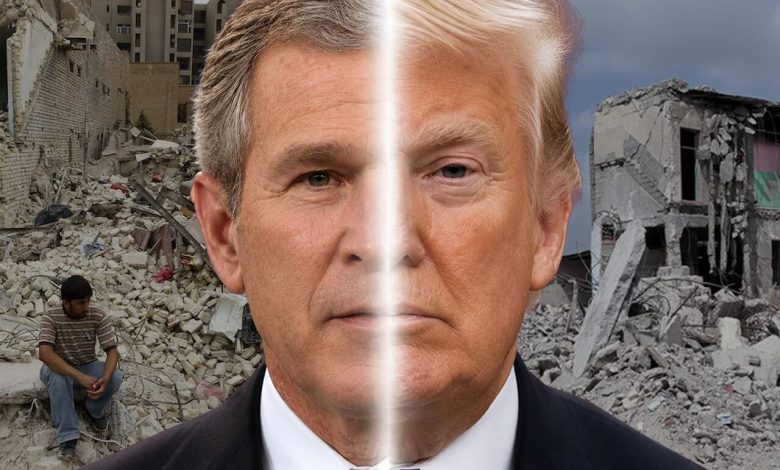
According to IRNA , the American bimonthly magazine “Current Affairs” wrote a harshly critical article: Three months have passed since the joint US-Israeli attacks on Iran began on February 28 , an attack that led to the assassination of the Iranian leader and the massacre of students at the Minab School. Since then, the war against Iran has become a disaster whose dimensions are expanding day by day.


Every day we have seen American soldiers returning in coffins; some 2,100 civilians have died across the region (and counting); a truce was declared in April, despite which the US continues its attacks in southern Iran; and, on top of that, the continued blockade of the Strait of Hormuz, which has led to a sharp increase in global energy prices and exacerbated the cost of living crisis for ordinary people around the world.
One can imagine a world in which Obama had not failed at his historic moment and Bush had been tried and convicted for his crimes in The Hague in 2010 or 2011. In this “parallel world,” Bush might have been imprisoned in a penitentiary in Europe. In the press and media, a growing consensus has emerged that Donald Trump’s war has been a strategic failure. However, less attention has been paid to the fundamental fact that the war, whether successful or not, was fundamentally “wrong.”
Several factors played a role in the beginning of this war, as is often the case when the US attacks another country. These include Trump’s psychological and personality traits and his desire to project power on the world stage; behind-the-scenes pressure from Benjamin Netanyahu and Israel; the financial interests of American arms companies; and, yes, even the public’s distraction from the disturbing revelations surrounding the Jeffrey Epstein case. However, there is another factor behind the US attack on Iran that is not sufficiently addressed: “the sense of impunity that was invented after George W. Bush’s invasion of Iraq,” an attack that was buried under piles of dirt without any serious consequences for its perpetrators.
The similarities between the 2026 invasion of Iran and the 2003 invasion of Iraq are obvious. Like Trump, Bush promised a quick and easy victory, with the “small” difference that the war led the United States into a much longer and bloodier conflict than his propaganda predicted. Like Trump, he killed a large number of civilians, the exact number of whom remains a closely guarded secret. In both cases, there was a unilateral invasion of an independent country in the Middle East that had never attacked the United States, and as a result, both are clear examples of “aggressive war.”
In international law, aggression is a “pure crime” and one of the major crimes for which Nazi German officers were hanged at the Nuremberg trials. According to Robert Jackson, the then US chief prosecutor, the main purpose of that trial was to institutionalize that actions such as the invasion of Poland would never be acceptable and that human civilization could not condone such crimes.
Yet, more than twenty years after the invasion of Iraq, Bush and his associates have never faced serious punishment. Bush is still considered a “respectable” figure in mainstream American politics, and is sometimes even portrayed more positively than the much lower-level and more psychologically unstable Trump. Regardless of what is written on paper in international law, the immunity of American presidents has become an unwritten law; the idea that they can invade countries in the Middle East and even commit gross human rights violations and get away with it. And so, decades later, Trump has walked through the gate that Bush left wide open, confident that he too will not face serious consequences for his actions.
Things could have gone differently. Between 2000 and 2010, many people made honorable efforts to hold Bush accountable for the crimes he had committed, and if they had been listened to and supported, the world might have been a very different place today. One of the first was former US Congressman Dennis Kucinich, who in July 2008 launched an impeachment inquiry against Bush, accusing him of “persistently providing misleading and deceptive information to Congress about the existence of weapons of mass destruction in Iraq”—information that, according to Kucinich, led to “the deaths of more than a million innocent Iraqi civilians.”
In the author’s opinion, these accusations were true, regardless of the disagreements about the exact number of victims, and everyone was aware of them. Of course, by 2008, it was too late for impeachment, as Bush’s term was coming to an end. However, impeachment could at least serve as a lesson to future presidents that there will be some kind of punishment for lying and mass murder. However, the Kucinich plan stalled in congressional committees, and Democratic leaders in the House of Representatives, especially Nancy Pelosi, who was the speaker of the house at the time, considered it too “divisive,” and as a result, there was no news of justice being served in Congress.
Malaysia was the first country to convict Bush, in 2011. It did so through a body called the Kuala Lumpur War Crimes Commission, which was set up by then-Prime Minister Mahathir Mohamad in 2007 as an alternative to the International Criminal Court. Like many countries and think tanks in the global South, Mohamad could not ignore the fact that the ICC, in its first decade, had mainly prosecuted African leaders, while ignoring far more powerful figures like Bush and Tony Blair.
As a result, in November 2011, the commission, adopting a “we’ll do it ourselves if we have to” approach, held a four-day trial of Bush and Blair, trying them in absentia. The problem, of course, was that the Kuala Lumpur court had no means of enforcing its ruling. The most it could do was to send its findings to the International Criminal Court and the United Nations and ask them to take action, which they never did. However, thanks to Malaysia’s action, Bush can now be accurately called a “convicted war criminal.”
It was Barack Obama who had the power and authority to hold his predecessor accountable, but he refused to do so. Many institutions urged him to take a different path, but at a critical moment, he announced, with melodious but empty rhetoric, that no charges would be filed. The Obama administration went even further, in some cases obstructing others’ efforts to seek justice. When an Iraqi refugee named Shakir Saleh sued Bush in a California court, the Obama administration stood up for him on his behalf.
This was a defining moment in history, and Obama made a huge mistake, and the position he took had disastrous consequences for the world. The argument of supporters of the decision in 2009, including Lindsey Graham, an American warmonger and ardent Trump supporter, was that it would be a “very bad heresy” for a president to prosecute officials from a previous administration. But what supporters of the decision failed to consider, or chose to ignore, was that not prosecuting would also be a heresy.
If the concept of “international law” is to have any real meaning, the Trump administration should be prosecuted for its war crimes. That includes Trump himself, J.D. Vance (Vice-President), Pete Hegsett (Secretary of War), Marco Rubio (Secretary of State), and the whole blood-soaked gang. Their guilt is not that hard to prove. One can imagine a world in which Obama had not failed in his historic moment and Bush had been tried and convicted in The Hague in 2010 or 2011 for his crimes. In this “parallel world,” Bush might be imprisoned in a European penitentiary. In such a world, Trump, even if he had become president, would have known that such actions would have consequences and would therefore have been much less likely to launch a criminal war on Iran. In that case, all those schoolgirls from Minab might still be alive and doing their homework. But we don’t live in that world.
But that doesn’t mean it can’t be achieved. It’s a shame that Dick Cheney was allowed to die free and wealthy. But Bush, even more than Netanyahu, still lives among us as the greatest mass murderer of the 21st century. All it takes is a government with a little political backing to arrest this fugitive from justice and right a great historical wrong.
If the concept of “international law” is to have any real meaning, the Trump administration should be held accountable for its war crimes. That includes Trump himself, J.D. Vance, Pete Hegsett, Marco Rubio, and the whole blood-soaked gang. Their guilt is not hard to prove; they proudly boast about their actions every day online, posting videos of blowing up and shooting at fishing boats or threatening to “totally destroy a civilization in Iran.” Aside from the invasion of Venezuela and the mass violence they have inflicted on the Cuban people in recent months, they have committed only one act of outright genocide: Gaza.
It will undoubtedly be difficult to prosecute a former US president; it has never been done, and Trump’s army of die-hard MAGA supporters will do everything they can to prevent it. But the consequences of not doing so are dire. If Trump and his allies, like Bush and his cohorts, get away with it, there will be virtually no limits to the killing; the UN Charter and the Geneva Conventions can be torn up and even used as wastepaper for animal cages. This must not be allowed to happen.