Criminality Continues Despite the Arrest of the Leader of the MKO in France in 2003
Association for Defending Victims of Terrorism - The attack by French anti-terrorist police on June 17, 2003, on a large number of the organization's bases and the arrest of Maryam Rajavi and 165 of its top cadres became the most newsworthy topic of the day in France and the world.

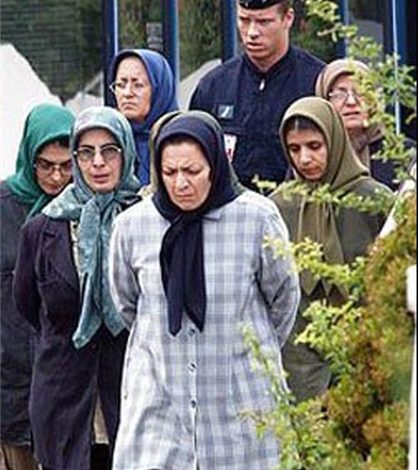
According to the Islamic Revolution Documents Center, the presence of Albanian police at the MKO Terrorists headquarters in that country attracted media attention. But this was not the first time that the MKO Terrorists had faced such measures on the anniversary of the 30th of Khordad(20 June). In late June 2003, senior members of the MKO Terrorists who had been caught off guard and fled to France after the US attack on Iraq were arrested by French police. The arrest of Maryam Rajavi, the organization’s second-in-command, in this incident became the main news in the world media.
Seyyed Hojjat Seyyed Esmaili, a former member of the leadership council of the terrorist group MKO, writes in his memoirs in this regard: The attack by the French anti-terrorist police on June 17, 2003, on a large number of the organization’s bases and the arrest of Maryam Rajavi and 165 of its top cadres became the most newsworthy issue of the day in France and the world.


The coverage of this incident was very rapid. In this regard, the New York Times newspaper stated that the French government’s motive for this action was “to prevent the transfer of the political-operational center of the People’s Mojahedin Organization from Iraq to France.”
Pierre Dubosquet, head of the French intelligence agency, stated in an interview with the newspaper: “French intelligence agencies have noticed the arrival of a large number of Iraqi soldiers in France since last fall, after the [beginning] of the Iraq war… The Mujahedeen [People’s] Organization rented a paint factory in the city of Saint-Quentin-Lamont and, while setting up a television studio and installing satellite dishes, are turning it into a communications center…
The MKO Terrorists had planned to attack Iranian embassies and other Iranian interests in Europe and assassinate 25 of its former members… This [organization] was not and is not a political movement in any way, a democratic and political movement.
“This group is not preparing itself to restore democracy in Iran. They are a completely extremist group. A radical sect, lacking any democratic system; a cult of personality in following the leader (autocrat).”
The arrest of Maryam Rajavi took place at a time when the fever of the fatal blow of Saddam’s fall had not yet subsided in the lives of the MKO Terrorists. This shock was so strong that it panicked the leaders of this terrorist group, especially Massoud Rajavi, and forced them to react.
The uncertainty of the French court’s decision and ruling, the possibility of Maryam Rajavi and some other arrested cadres being extradited to Iran, and most importantly, the disruption of carefully planned arrangements and logistics, led the terrorist group to think of a response commensurate with its sectarian nature in order to prevent further French measures, which the MKO terrorist group assessed as much stricter than the current situation.
The reality is that the MKO Terrorists had always tried to present a non-terrorist image in the global arena to advance their goals and gain international support, but this time they were in a situation where they had to do something to free Maryam Rajavi and the other detainees.
Following this incident, the MKO Terrorists continued to threaten to put hundreds of people on a self-immolation list and that they were determined to set themselves on fire if the French government did not end its joint conspiracies with Iran.
However, contrary to Rajavi’s assessments, this incident faced the MKO Terrorists with more serious challenges in the political arena and at the international level.
This challenge was the result of the confrontation between civil and democratic indicators in the West and the spirit of social anarchism and unbridled adventurism prevailing among the MKO Terrorists, who, under the guise of idealism, attempted to establish themselves as equals by identifying and counterfeiting themselves with the most genuine part of the anti-fascist resistance in Europe.
Self-immolation of members; organizational order
The arrest of Maryam Rajavi and its consequences at least provided the governments and public opinion of Europe with the opportunity to see beyond the surface of this organization. This harsh, moving, and reactionary reaction was in fact the MKO’s minimal response to a simple problem that could have been corrected under any assumption.
In response to the arrest of Maryam Rajavi and a number of its high-ranking members, who were forced to uncover and pursue allegations, including money laundering and the physical elimination of some of their defected members, based on an organizational order, the MKO forced a number of its members in Europe to self-immolate. The terrorist group’s goal in this action was to put pressure on France and force the release of the arrested individuals, specifically Maryam Rajavi. Following this organizational action across Europe, dozens of members of the MKO committed self-immolation in front of stunned citizens. The result of this psychological blackmail was two victims named Neda Hassani and Sedigheha Mojaveri. In addition, a person named Mohammad Thani, a senior MKO Terrorists official, was also injured in this incident.
The pressure caused by this incident on the government, its politicians, and public opinion was so great that it overshadowed all the standards and laws in force in France, and the French court was forced to adjust its positions to avoid possible further costs, which were mainly imposed on its own public opinion.
Rajavi’s confession that the MKO is a terrorist organization
The June 17 incident and the series of self-immolations by members of the MKO had the opposite effect. Contrary to the predictions of the MKO organization, public opinion and the people of Europe and other countries reacted negatively, provoking a wave of disgust, hatred, and surprise.
Following these reactions, the MKO Terrorists claimed that these movements were spontaneous and spontaneous, and that their members did not commit self-immolation under organizational orders.
As Massoud Rajavi once said in a public meeting (addressing Europeans and Americans – the quote is in context): Gentlemen, don’t think that we who wear suits and ties can do whatever they want to us and have the Iranian air. If we start working, we will become terrorists from whom you will no longer be safe (the audience applauds and whistles for Rajavi, and in return, Rajavi laughs and giggles. Rajavi then asks the crowd with the same laugh: Are you terrorists? The audience says loudly: Yes!
The experience of the presence of the MKO Terrorists in France shows that this terrorist group was supported by this country and that this type of arrest was carried out in order to establish greater surveillance over this terrorist group.