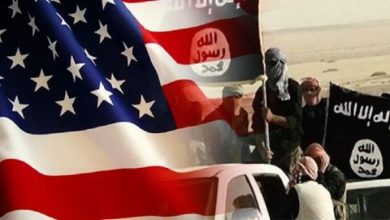

In this report , we read that a documented account of the systematic use of Takfiri terrorist groups by the United States to advance its geopolitical interests was published in a specialized study.
This research, published in the summer issue of the “Security Horizon” journal under the title “America and the Use of Terrorism in Future Competitions with China and Russia,” relies on documents, field evidence, and a review of America’s behavior in recent decades. It shows that Washington has purposefully used extremist terrorist groups as a tool in its foreign policy and geopolitical competitions.
Scholars emphasize that the United States’ classic strategies for maintaining global influence—including relying solely on military power and economic mechanisms—are no longer adequate to serve its interests in today’s multipolar international system. They believe that with the changing nature of competition among great powers, traditional patterns of power exercise have largely lost their effectiveness.
According to this analysis, in conditions of economic interdependence and nuclear deterrence, the United States and other global powers prefer to transfer their competitions and confrontations to proxy arenas and third geographies in order to avoid direct military confrontation.
Within this framework, this study concludes that over the past two decades, the United States has gradually used Takfiri terrorism as an effective tool to influence and weaken its rivals in sensitive regions of the world.
Organizing Terrorism: From Social Discontent to Geopolitical Interests
This study further proposes the concept of “organizing factor” and emphasizes that in addition to the factors that create and intensify the emergence of terrorism, such as social, economic, political dissatisfaction, etc., what turns terrorism into an organized phenomenon is the geopolitical interests of international and regional powers as a sufficient condition for the formation of terrorist groups.
American officials also acknowledge that without government sponsors, terrorist groups would have a much more difficult time obtaining the funding, weapons, materials, and safe areas needed to plan and carry out operations.
Accordingly, two main approaches are identified in Washington’s behavior: first, the negative aspect, which is mainly carried out by labeling opposing actors as sponsors of terrorism in order to exert pressure on them; second, the positive aspect, which is mainly carried out through covert material support (military, intelligence, economic, logistical, etc.).
Political labeling under the title of “fighting terrorism”
In the first part, the research examines the period after the September 11 attacks; a period in which the United States, by presenting the doctrine of the “war on terrorism,” gave itself the right to target non-aligned countries with direct attacks or severe sanctions.
As a result, Afghanistan and Iraq became military battlefields, and countries such as Iran, Syria, and North Korea were subjected to more severe sanctions due to this label. Even countries such as Libya were forced to retreat and join disarmament plans, threatened with repeating the fate of Baghdad and Kabul.
The researchers point to the US labeling cycle and explain that this pattern has been used against Russia and China in subsequent years. They say this same approach has encouraged the US to put Russia on the list of state sponsors of terrorism, citing Moscow’s actions in Chechnya, Georgia, Syria and Ukraine.
In this context, the media and some American political figures have attempted to solidify Russia’s image as a state sponsor of terrorism by highlighting cases such as the targeting of Alexander Litvinenko and Sergei Skripal in England, as well as claims that Russia sheltered groups such as the “Russian Imperial Movement” active in the Ukrainian war.
Simultaneously with this media atmosphere, a number of US Congress members have presented plans during 2022-2023 aimed at increasing pressure on the State Department to officially identify Russia as a state sponsor of terrorism.
In this regard, Ned Price, then-Speaker of the US State Department, has announced that the sanctions that Washington has imposed against Russia are similar in nature to measures that are usually implemented against states that support terrorism.
The United States has also used the same pressure and labeling tools to threaten and bargain with China in bilateral negotiations. Washington has tried to intensify its political and security pressure on Beijing by making claims about the actions of the Chinese Navy and even its Coast Guard against American military ships and aircraft in the East and South China Seas, Beijing’s failure to prevent Chinese drug exports to the United States, China’s close relations with countries that the United States has designated as state sponsors of terrorism, such as North Korea, Iran, Syria, and Sudan, and the repression of the Uyghurs in the Xinjiang region.
In this regard, the US government announced in 2021 that Chinese authorities in Xinjiang had committed genocide and crimes against humanity.
Covert support for terrorism as a balancing tool
In the second part, this research addresses the issue that, as the effectiveness of the negative approach to terrorism in achieving America’s strategic goals has decreased, Washington has gradually moved towards a more active and risky policy.
According to this analysis, this policy has been pursued in two directions: first, directly strengthening and supporting terrorist groups within or around geographical areas close to China and Russia; second, indirectly supporting terrorism in areas where these two powers have strategic interests or allied states.
Analysts believe that proxy forces have become the most suitable tool for engaging rivals due to their low cost, high flexibility, and the ability to deny a direct role; a tool that allows the sponsoring country to easily deny any direct involvement or intervention in conflicts.
According to the authors of the study, the most significant manifestation of American support for Takfiri terrorism against the great powers can be seen during the Cold War. After the Soviet Union’s military occupation of Afghanistan in 1979, the United States, in cooperation with some regional countries, including Pakistan and Saudi Arabia, turned to widespread support for radical Islamists in Afghanistan in order to counter Soviet influence.
In this context, former US Secretary of State Hillary Clinton has stated in statements that al-Qaeda was formed with US support because Washington did not want the Soviet Union to dominate Central Asia. According to this view, the US approach to fundamentalist movements has always been instrumental and their use has been defined within the framework of the principle of maintaining US strategic superiority and dominance.
In this regard, former US Secretary of Defense Casper Weinberger, in explaining America’s support for the Afghan Mujahideen, said: “We knew they were not very good people, but we had to choose them.”
Extremist terrorism and direct pressure on Russia; from the Caucasus to ISIS
According to the study, Russia’s most significant internal security threat comes not from classical powers, but from radical Islamic groups in the North Caucasus. Russia, with about 20 million Muslims, who make up 13-15 percent of the country’s total population, has been facing the problem of religious extremism for years, especially in the autonomous republics of the North Caucasus.
The Chechen separatist movement in the 1990s, which initially had an ethno-political nature, gradually changed its nature under the influence of Salafist movements and allegiance to Al-Qaeda, and was redefined as a group called the “Islamic Emirate of the Caucasus”.
This process entered a new phase in November 2014 with the leaning of some of these groups towards ISIS, and finally reached its peak on June 23, 2015, with the official announcement of the formation of the “ISIS Caucasus Province.”
Some statistics show that since 2011, between 900 and 2,800 Russian citizens have left the country for Syria to join fundamentalist groups, an issue that has made the possible return of these individuals one of Moscow’s strategic national security challenges.
The report continues by stating that since April 2016, ISIS has been attempting to connect extremist Islamists from the Caucasus and Central Asia to its operational network by using the Al-Hayat media outlet and publishing propaganda videos in Russian.
In contrast, the activities of ethno-religious groups in the Caucasus have always been attractive to the United States in order to implement its policy of containing Russia. According to some sources, the United States, along with Al Qaeda, has played an important role in the Chechen crises.
In this context, some Russian intelligence sources and political officials, including Vladimir Zhirinovsky, have explicitly stated that Western intelligence agencies are playing a role behind the scenes of Salafist movements in Russia.
In the next section, the research addresses the situation in China and emphasizes that the issue of Muslims in this country, especially in the Xinjiang region, has at times been linked to fundamentalism and extremism, and radical and hardline Islamists have become a political force.
According to this analysis, extremist groups operating in the form of the “Turkistan Islamic Party” operating inside and outside China have established extensive ties with Al-Qaeda, the Taliban, and ISIS and have become known as the “Chinese ISIS.”
Meanwhile, while Chinese authorities accuse Uyghurs of committing terrorist acts, the United States claims that there is no clear and convincing evidence of the existence of the East Turkestan Islamic Movement in Xinjiang and the connection between the people of this region and the aforementioned group.
The United States has passed retaliatory legislation in response to China’s actions against Muslims. Such as the “Uyghur Human Rights Policies” Act passed by the Senate on September 11, 2019, the “Uyghur Act of 2019” on December 3, 2019, and another law passed by the US Congress in 2020 in support of Chinese Muslims.
According to analysts, given the increasing strategic competition between China and the United States and the continuing challenges and tensions between Beijing and the Xinjiang region, it is likely that Washington officials will move towards providing military and arms support to groups and movements active in Xinjiang in the next steps; support that will be justified and pursued under the claim of supporting “liberation movements.”
Central Asia: The New Battlefield for Proxy Wars
Researchers further warn that Central Asia has become one of the most susceptible regions for implementing American strategies due to the presence of numerous radical groups such as the Islamic Movement of Uzbekistan, Ansarullah Tajikistan, the Islamic Movement of Turkestan, the Islamic Jihad Union, the Ikramia Organization, and the Jund al-Khilafat, as well as branches of ISIS.
Central Asia is one of the regions that has the highest priority in Russian foreign policy, because for Moscow, the material interests of this region are linked to another major goal: maintaining its image as a great power.
Meanwhile, the presence of significant energy resources in this strategic area has led China to show increasing attention to Central Asia. In addition to the geopolitical proximity and transit importance of this region for China, concerns about sensitive border areas such as Xinjiang have also increased China’s sensitivity to developments in this area.
In this context, it seems that since 2019, by publishing a strategic document with a 2025 horizon, the United States has attempted to expand its influence in Central Asia and, while promoting American values, create a kind of balance against the influence of regional neighbors.
The 2022 US National Security Strategy states: “Today’s terrorist threats are more ideologically diverse and geographically dispersed than they were two decades ago; therefore, when necessary, we will use force to disrupt and destroy terrorist groups that are plotting to attack the United States, our people, or our diplomatic and military facilities abroad.”
However, given the decline in the effectiveness of conventional US tools against China and Russia, Central Asia could become a platform for Washington’s unconventional strategies; strategies that are pursued either maximally and actively by arming Salafi groups opposed to governments aligned with Russia and China and forming a kind of proxy war, or minimally and passively by ignoring the movements of these groups to carry out destructive operations against the interests of Moscow and Beijing.
This is while, under normal circumstances and throughout history, Central Asia itself has been neither a top security priority nor a key economic partner for the United States, as the region accounts for less than one percent of Washington’s global trade.
West Asia at the Center of Hegemonic Competition
In the final section, this study examines West Asia as the most important arena of America’s indirect support for terrorism with the aim of pressuring Russia and China.
This region is of strategic importance to Russia for several reasons, including its geographical proximity and proximity to West Asia through Iran and Turkey, the presence of a significant Muslim population in Russia and its ties to Muslims in the region, the vast energy resources in West Asia, and the region’s high capacity for trade, investment, and the sale of Russian weapons and military equipment.
On the other hand, stability in West Asia is one of the key goals of China’s development strategy, as maintaining the security of this region plays a decisive role in ensuring Beijing’s sustainable access to oil and gas resources.
In addition to the issue of energy supply, the religious ties of Xinjiang extremists to countries in the region, the capacity and attractiveness of the markets of West Asian countries, and mutual investment between China and Middle Eastern countries in economic sectors are other factors that are considered to be Beijing’s special attention to this region.
The combination of these components has led some analysts to consider West Asia one of the most important geopolitical regions in the world, exposed to the direct impact of the hegemonic competition between the United States and China.
Citing Edward Snowden’s revelations about Operation Wasp Nest, the authors of the article emphasize that the United States played an active role in the formation of ISIS and used Takfiri terrorism as a tool to manage and destabilize the region.
According to researchers, the existence of weak governments, ethnic-religious divisions, poverty, and the high ability of radical Islamic groups to act have made West Asia an ideal environment for implementing this strategy.
Using terrorism as an instrument against Iran
One of the most important reasons and variables that encourages America to use terrorism as a tool in West Asia is the location of the Islamic Republic of Iran in this region.
Iran has important economic and military relations and cooperation with Russia and China, ranging from bilateral and multilateral agreements such as the 25-year Iran-China Cooperation Agreement to cooperation within the framework of regional and trans-regional organizations such as the Shanghai Cooperation Organization and the BRICS group. The intersection of these three components—the importance of West Asia for China and Russia, Iran’s geopolitical position in the region, and the trilateral cooperation between Iran, Russia, and China—has led to the formation of a special American view of West Asia.
Accordingly, one of the main US strategies to weaken the axis of resistance has been to use proxy wars relying on terrorist and Takfiri groups; a strategy whose peak of application has been clearly visible during the Syrian civil war since 2011.
Multilateral solutions to counter American-Takfiri terrorism
In order to effectively confront Takfiri terrorism and American support for these groups, researchers have proposed a set of solutions and suggestions that emphasize strengthening regional and international cooperation.
Based on these views, expanding and promoting bilateral and multilateral economic, military, and intelligence cooperation among countries that oppose America’s unilateral actions in the international system – including Iran, Russia, and China – is introduced as one of the main axes of combating terrorism.
It has also emphasized the distinction between true Islam and deviant Takfiri movements by countries such as China and Russia, and the avoidance of provocative actions against Muslims in Muslim-populated areas of these countries; an action that can prevent the social conditions for the growth of extremism.
Within this framework, assistance and cooperation with countries affected by the activities of Takfiri groups for the political and economic development of regions prone to the growth of terrorism, especially in Central Asia and some Middle Eastern countries such as Syria and Iraq, are other suggested solutions.
The proposals also emphasize making regional and trans-regional organizations such as the Shanghai Cooperation Organization, ECO, and BRICS more dynamic and activating the economic and military capacities of these institutions in the field of combating terrorism.
On the other hand, given the ideological nature of Takfiri groups, planning for a cultural confrontation with these trends, alongside military measures, has been proposed as a strategic necessity.
Finally, exposing America’s cooperation with terrorist groups with the aim of delegitimizing the country’s claim of anti-terrorism and increasing global public pressure against Washington’s instrumental use of terrorism is another key focus of these proposals.