British government classifies protest as terrorism
Association for Defending Victims of Terrorism – According to Al Jazeera, the UK's comprehensive terrorism laws classify direct action and political expression as terrorism, thus giving counter-terrorism agencies jurisdiction over these matters.

Tony Greenstein, an anti-Zionist Jew and a founding member of the Palestine Solidarity Campaign, warned in an article in Al Jazeera English against expanding the definition of terrorism in British law.
When most people are asked what terrorism is, they say it is the use of violence and terror to create fear among people, writes Tony Greenstein . This is the common dictionary definition. The 2017 Manchester Arena bombing at an Ariana Grande concert, which killed 22 people, including many children, is a prime example.


However, the legal definition of terrorism in the UK is much broader than this common understanding. Section 1 of the Terrorism Act 2000 even classifies “damage to property” as terrorism if it is committed for political, religious, racial or ideological purposes and is intended to influence a government or to intimidate the public. The latter requirement does not apply where firearms or explosives are involved.
The inclusion of political damage to property in this definition was controversial from the start. When Parliament debated the bill in 1999, animal rights activists were among the groups MPs had in mind.
Alan Simpson, a Labour MP, warned during the debate that by defining attacks on property as terrorism, “we are changing the relationship between civil protest movements and elected parliaments and the justice system.”
The criticism was not limited to Parliament. The Supreme Court later described the definition of terrorism in Section 1 as “extremely broad”, while David Anderson, the independent Terrorism Act Inspector, called it “remarkably broad – and in some cases ludicrously broad”.
In his 2014 terrorism report, he warned:
“Restricting people who no sane person would consider terrorists risks destroying the trust that these special powers depend on for public acceptance.”
However, defining what constitutes terrorism is only part of the story. Not every organization whose behavior falls within this definition is prohibited. That decision is up to the government.
Therefore, the ban adds a political choice: which organizations should be banned, and membership and advocacy in them should be criminalized.
For example, the Kurdistan Workers’ Party (PKK), a Kurdish armed group that has been fighting the Turkish government for decades, is banned in the UK. Its Syrian branch, the Democratic Union Party (PYD), is not banned because PYD-led forces have become Western allies in the fight against ISIS.
The UK sanctioned Hamas’s military wing in 2001. In 2021, Home Secretary Priti Patel extended the sanction to all of Hamas, including its political wing, declaring the previous distinction between the two “artificial.” Many civilian members of Hamas who had never taken up arms were now considered terrorists alongside its fighters.
By eliminating the distinction between Hamas’ military and political branches, Britain legitimized Israel’s portrayal of the civilian Hamas government as part of a terrorist apparatus and, consequently, the targeting of hospitals and schools as terrorist infrastructure.
This asymmetry is starkly apparent. British terrorism laws can criminalize NGOs and those who support them, while state terrorism, including Israeli terrorism, remains beyond their reach.
The banning of Palestine Action has highlighted another consequence of these laws: their use against protests in the UK. Palestine Action is a British direct action group that has targeted arms companies that supply Israel. In July 2025, the government banned the group under the Terrorism Act 2000.
UN High Commissioner for Human Rights Volker Turk warned that the decision to ban the Palestinian action “raises serious concerns that anti-terrorism laws are being applied to conduct that is not terrorist.”
The ban has been heavily contested in the courts. In February 2026, the District Court ruled the ban illegal. On June 15, the Court of Appeals overturned the decision and upheld the ban. The court also described Elbayt as operating a “legitimate business” and ignored its role in supplying Israel with military equipment during the genocide.
In upholding the ban, Chief Justice Sue Carr contradicted the Suffragettes, saying that the Palestine Action Group was not “a direct action civil disobedience protest group like the Suffragettes, which operates openly and transparently,” but rather “a clandestine group that operates in a cell-by-cell manner.”
The characterisation of the work is based on an extremely artificial account of the history of the women’s suffrage movement.
In November 1909, a suffragette attacked Winston Churchill with a whip. In the same month, suffragettes, armed with catapults and rockets, attacked Prime Minister H.H. Asquith’s car in Liverpool.
In 1912, suffragettes attempted to set fire to the Theatre Royal in Dublin during an afternoon performance featuring Squitt. They left a tinderbox near the stage. Mary Lee had previously thrown an axe at Squittt.
In 1913, four postmen in Dundee were seriously injured by phosphorus chemicals left in letter boxes. The following year, Mary Richardson blew up the Venus Rokeby statue in the National Gallery, while bombs were discovered in St Paul’s Cathedral and churches were set on fire.
This history is inconsistent with the distinction. The women’s suffrage movement itself was involved in politically motivated attacks on property and people, precisely the kind that the modern British definition of terrorism is broad enough to encompass.
The Filton case shows what this could mean in practice. When Filton, 25, attacked an Elbit factory in Bristol, they were held in custody for 18 months. When six of them went on trial in November 2025, the jury acquitted them of aggravated robbery, the most serious charge, and failed to reach a verdict on punitive damages. No defendant was convicted at that first trial. At the retrial, four were convicted of punitive damages. Ultimately, only one was convicted of grievous bodily harm without intent.
The jury was not told that the convictions could later lead to the crimes being considered for punishment as “terrorist connections.” Judge Jeremy Johnson subsequently made exactly the same ruling. Johnson also rejected the defenses based on necessity and the need to prevent the larger crime of genocide. In doing so, he usurped the role of the jury.
The consequences of this ban were not limited to those accused of taking direct action against Al-Bayt. Once the Palestine Action group was banned, calling for or expressing support for the group became a terrorist offense.
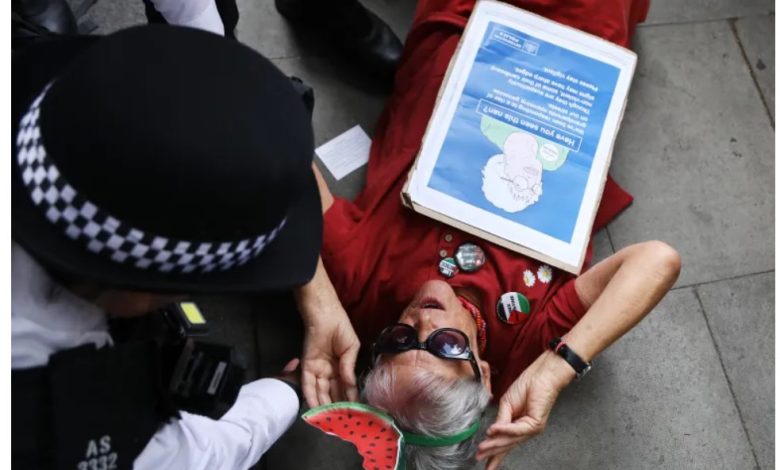
When the government banned the Palestine Action movement, people defied the ban. Nearly 4,000 people have been arrested for holding placards in support of Palestine Action.
The Interior Ministry reported that in the year to March 2026, there were 3,061 terrorism-related arrests, 2,819 of which were related to suspected support for the Palestine Action Movement. The average age of those arrested in connection with the Palestine Action Movement was 59 years old, while the average age of other terrorism-related arrests was 31 years old. The majority of those arrested for the Palestine Action Movement were women.
The average age of a “terrorist” in Britain changed from a 31-year-old man to a 59-year-old woman.
Britain’s extraordinarily broad definition of terrorism, coupled with the government’s power to ban organisations, has led to behaviour that was once seen as protest and political expression now being prosecuted under terrorism legislation.
As Orwell wrote, “If thought corrupts language, language can corrupt thought.” When the meaning of “terrorism” becomes broad enough, the extraordinary powers attached to the word expand with it.
The views expressed in this article are the personal views of the author and do not necessarily reflect the position of the Association for Defending Victims of Terrorism.